A Defensible Ruling. An Indefensible Landscape.
The questions people are asking about the Virginia ruling. And where the real injustices are (hint: not in Virginia).

Predicted it. Didn’t want to be Right.
There is a version of today’s Virginia redistricting ruling that is too easy to indulge. A partisan court handed Republicans a massive political victory on a map designed to flip four congressional seats. Simple.
I don’t think that version is entirely accurate. And I have some standing to say so, because I have been saying the same thing since October. I said it again two weeks ago, after the trial court enjoined the referendum-approved map. The message wasn’t especially welcome.
Partisan me laments the result. Principled me predicted it and thinks the ruling is defensible. The reaction since the decision came down suggests there is real confusion — and real anger — about several different things at once. Some of that anger is entirely justified. But much of it is aimed at the wrong target. Let’s try to clarify some questions that recur in the discourse.
Was this lawsuit frivolous?
No. When it was filed, I thought Democrats had a real problem. I said as much on national television. Here is a short, representative exchange with Katy Tur after the trial court ruled the redistricting legislation was void ab initio — void from the beginning, as if it had never existed. In the clip, I note that the trial court judge identified seven problems. The one I seized on then is precisely the one the majority seized on in the ruling.
To put it mildly, saying so was not universally welcome. Especially not with the political left.
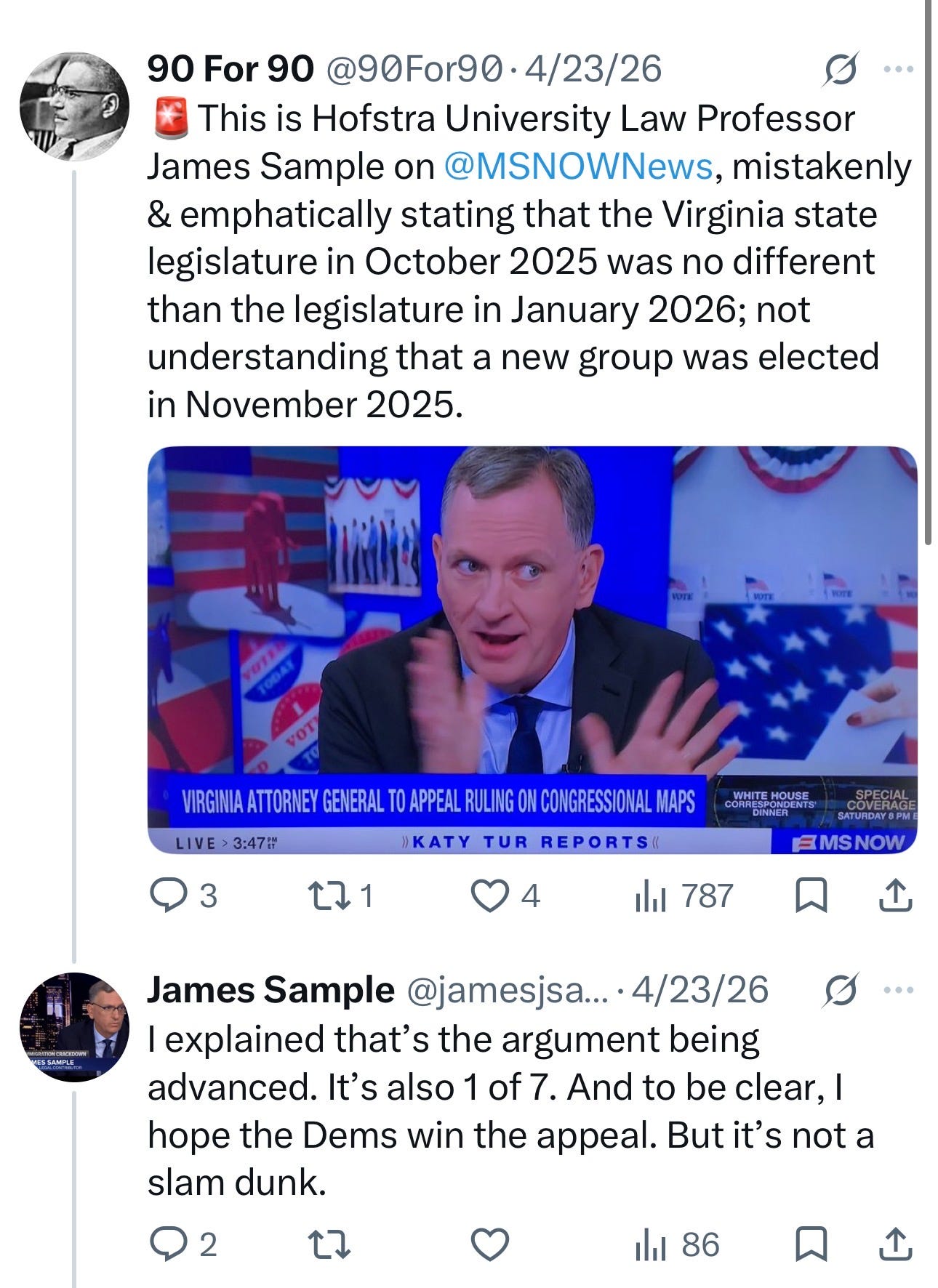
The criticism — that I was ‘mistakenly and emphatically’ stating the October 2025 and January 2026 legislatures were no different — misreads what I said. I was describing the argument the Democrats were advancing, one of seven grounds on which Judge Hurley ruled. I was the one telling a politically aligned audience that the ruling against them was not frivolous. I was explicit that I hoped they would win the appeal. I didn’t think it was a slam dunk.
Here is the exchange showing what I was actually pointing to — Judge Hurley’s order, with the ab initio findings right there on the page:
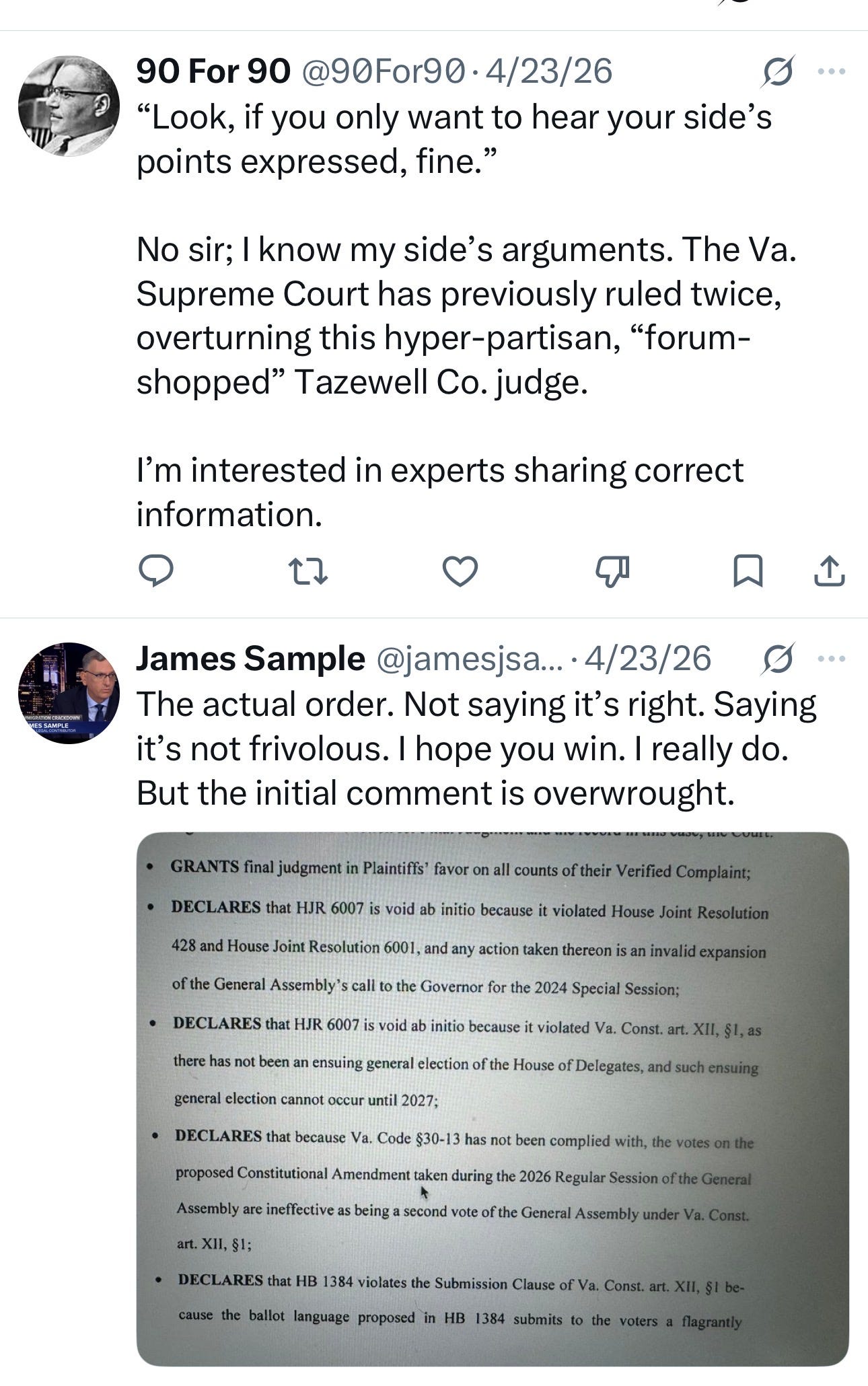
“Not saying it’s right. Saying it’s not frivolous. I hope you win. I really do. But the initial comment is overwrought.” That was my position in April. It remains my position today.
The Core [State] Constitutional Concern
The core of my concern was always the same: Virginia’s constitution requires a proposed amendment to pass the General Assembly twice, with a general election for the House of Delegates intervening between the two votes. The point of that requirement — as Justice Kelsey spelled out in Friday’s majority opinion — is to give voters the opportunity to factor a legislator’s position on a constitutional amendment into their choice of representative.
The General Assembly cast its first vote on October 31. Early voting for the November 2025 state elections had already been underway for weeks. More than 1.3 million Virginians — roughly 40 percent of all votes ultimately cast — had already cast their ballots before that vote happened.
That is a genuine constitutional problem, not a fabricated one. I hoped it would be resolved in Democrats’ favor. I didn’t think it would be.
One more thing worth noting for those inclined to dismiss the majority as simply partisan: Justice Kelsey, who wrote the majority opinion, faces reappointment by the Democratic-controlled General Assembly whose redistricting work he just invalidated. He ruled against the people who will decide whether he keeps his job. That is not the behavior of a justice maximizing political self-interest.
If the case was so clear, why did the Virginia Supreme Court let the referendum go forward before deciding it?
This is a fair question, and the full timeline makes the answer more complicated than it might seem.
Voters approved the referendum on April 21. The very next day — April 22 — Tazewell County Circuit Court Judge Jack Hurley issued a final judgment ruling that the enabling legislation was void ab initio: void from the beginning, as if it had never existed. Today’s ruling is the culmination of a legal process that has been running on this track since October.
What Justice Kelsey addressed in the majority opinion was a related but distinct complaint — that the court should be precluded from ruling at all, because the people had spoken. He was pointed about this: before the vote, the proponents argued that ruling on the constitutional question first would be premature. After the vote, they argued it was too late. The majority was having none of it.
Before the election, proponents argued ruling would be premature. After the election, they argued it was too late. The majority opinion addressed that both-ways argument directly.
You can disagree with how the court resolved the underlying constitutional question — the 4-3 split tells you reasonable jurists did. But the sequencing complaint is, at least in significant part, a consequence of the strategic litigation choices the proponents made along the way.
But wasn’t the structural redistricting fight already tilted against Democrats, even before today’s ruling?
Yes. Significantly. I explained this Thursday night on ABC News Prime with Linsey Davis here. In the short snippet embedded below, Linsey asked whether the redistricting war is a bilateral fight between the parties. She invariably asks the right questions. To this one, my answer was: yes and no.
Yes, both parties have been drawing aggressive maps. But no — the structural conditions are not equal, and they haven’t been for a long time. Here is that exchange:
The asymmetry runs in two directions. First, years ago, Democratic-controlled states like Virginia voluntarily installed independent redistricting commissions as a good-government reform, insulating map-drawing from legislative politics. Republican-controlled states kept the power in their legislatures. That institutional choice created an asymmetry that Republicans are now exploiting aggressively.
Second — and more acutely — the Supreme Court’s decision last week in Louisiana v. Callais changed the math in the South in ways that Virginia, even if it had survived legal challenge, could not have offset. More on that below.
Can the U.S. Supreme Court Overturn the Virginia Ruling?
Almost certainly not. Not even if it wanted to (and let’s be honest, the majority doesn’t want to anyway). Here is my exchange with Katy Tur today, on the [ahem] ratings juggernaut that is the Independent and Adequate State Grounds Doctrine.
Is it unfair that Virginia’s referendum gets voided while Louisiana just ignores voters who already cast ballots, Tennessee slices up Memphis, and Florida tears up its own constitution?
Yes! It’s totally unfair! But not because of Virginia. This is the right question, and it gets at what is actually indefensible about the current landscape. Tim Miller made this point powerfully and accurately today in our segment. That exchange is here:
Start with Louisiana. After Callais came down on April 29, Governor Jeff Landry declared an emergency, suspended a May 16 primary that was already underway — more than 42,000 people had already submitted absentee ballots — and called the legislature into special session to erase the state’s two majority-Black congressional districts. The Supreme Court then took the extraordinary step of waiving its standard 32-day waiting period to finalize the ruling in less than a week, giving Louisiana the green light to proceed.
Let that sink in. A state suspended an election that was already in progress, discarded the votes of thousands of people, and redrew its maps to eliminate Black political representation — with the Supreme Court fast-tracking its blessing.
Tennessee drew a new map that slices Memphis itself into three solidly Republican suburban districts. Memphis is a city of over one million people, roughly two-thirds of whom are Black. Yesterday, the Tennessee legislature deliberately diluted the political power of that community, carving it into pieces in surrounding white Republican suburbs.
Think about what that means geographically and historically. Memphis is the city where Martin Luther King Jr. was assassinated. Yesterday, the Tennessee legislature looked at that city and drew lines intended to ensure its people do not elect anyone to represent them.
Chief Justice John Roberts wants us to believe the South has changed so much that he and his colleagues know better than Congress that reauthorized the Voting Rights Act. In Shelby County, Roberts wrote that “things have changed dramatically” in the South. Memphis yesterday is his answer.
And then there is Florida. Florida voters approved a constitutional amendment in 2010, with 63 percent of the vote, that explicitly bans partisan gerrymandering. Governor DeSantis, citing Callais, has now argued that the entire Fair Districts Amendment is void — that because one provision touching on race may have been affected by the ruling, the entire voter-approved ban on partisan gerrymandering must fall with it.
In Florida, the governor and the challengers agree the new map breaks the state’s constitution. The governor’s position is simply that the constitution no longer applies.
Compare that to Virginia. The Virginia Supreme Court applied a genuine constitutional constraint about the proper process for amending the state’s own founding document. You can disagree with the majority’s reading of the word ‘election.’ The dissent does, forcefully. But the court was doing what courts are supposed to do — interpreting the law. It was not simply declaring that the law doesn’t apply because the results would be inconvenient.
That distinction matters. It does not make the outcome less painful. It does not offset what is happening in Louisiana, Tennessee, and Florida. But it is a real distinction, and collapsing it serves no one.
So where does the actual injustice live?
I wrote about this in April, in a piece called The War Nobody Wins. The redistricting war is real, both parties have been fighting it, and democratic representation loses regardless of who is holding the pen in a given session. That argument holds. But the war has taken a significant turn since that piece ran, and the turn is not symmetrical.
The chain runs like this. In 2013, Shelby County v. Holder gutted the preclearance requirement of the Voting Rights Act — the provision that required states with a history of racial discrimination to get federal approval before changing their election laws. The South did not wait long to demonstrate why that protection had existed.
In 2019, Rucho v. Common Cause held that federal courts have no role in policing partisan gerrymandering. Chief Justice Roberts acknowledged that extreme gerrymandering is ‘unjust’ and ‘incompatible with democratic principles.’ Then he said there was nothing the courts could do about it.
Last week, in Louisiana v. Callais, the Court’s 6-3 majority, in an opinion by Justice Alito, eviscerated Section 2 of the Voting Rights Act — the provision that had protected minority voters’ ability to elect candidates of their choice for six decades. Justice Kagan’s dissent put it plainly.
“Today’s decision renders Section 2 all but a dead letter.” — Justice Elena Kagan, dissenting in Louisiana v. Callais
The practical consequence is not abstract. States across the South are now racing to eliminate the majority-minority districts that existed precisely to ensure Black voters could elect someone who represented them. The eradication of Black political representation is not a side effect of this moment. It is the design.
President Trump started this particular race to the bottom when he pressured Texas to redraw its congressional maps mid-decade last year — breaking a norm that had held for generations — because his party needed the seats. What has followed is a cascade: Florida abandoning its own constitution, Tennessee cracking Memphis, Louisiana canceling an ongoing election, Alabama and South Carolina and Mississippi moving in the same direction.
That is what is indefensible. Not the Virginia Supreme Court’s reading of the word ‘election’ in Article XII of the Commonwealth’s constitution. The systematic dismantling — across a decade of Supreme Court decisions and a season of unchecked partisan aggression — of the legal architecture that once constrained the worst impulses of the politicians who draw the lines.
What comes next?
Virginia Democrats can try again. The court’s ruling was about process, not the substance of the map. The path forward runs through the next legislative session and the 2028 cycle. That is cold comfort when the midterms are six months away, and cold comfort for the Black voters in Louisiana and Tennessee and Florida whose representation is being erased right now.
But the energy that is currently directed at the Virginia Supreme Court — some of it aimed at people like me who won’t call the ruling illegitimate — is energy that would be better spent on the longer fight. The architecture of decisions that produced this moment was built over decades. Dismantling it will take at least as long.
Principled me knew this result was coming. Partisan me is still angry about it. Principled and partisan me is angry about the racism, the reversal of progress, and the fact that in the partisan-gerrymandering race to the bottom (mid-cycle no less) that the U.S. Supreme Court has willfully invited, 60% of the vote, might well produce 45% of the seats. All of those things can be true at once.
I’m glad you’re here. I’m grateful you’re engaged. Here and everywhere. — James
Exceptional piece outlining the painful truths of the current landscape James. Very dark time for our democracy and the democratic principles this country was founded on.
This is a hard read for those of us who poured everything into Vote YES. But it is an important one. The real injustice is not the Virginia ruling — it is Louisiana canceling an ongoing election, Tennessee slicing Memphis into three Republican districts, and a Supreme Court that gutted the Voting Rights Act and then fast-tracked the erasure of Black political representation.