Four Days. Three Branches.
May 2, 2026 · Week in Review

Four days. Three branches.
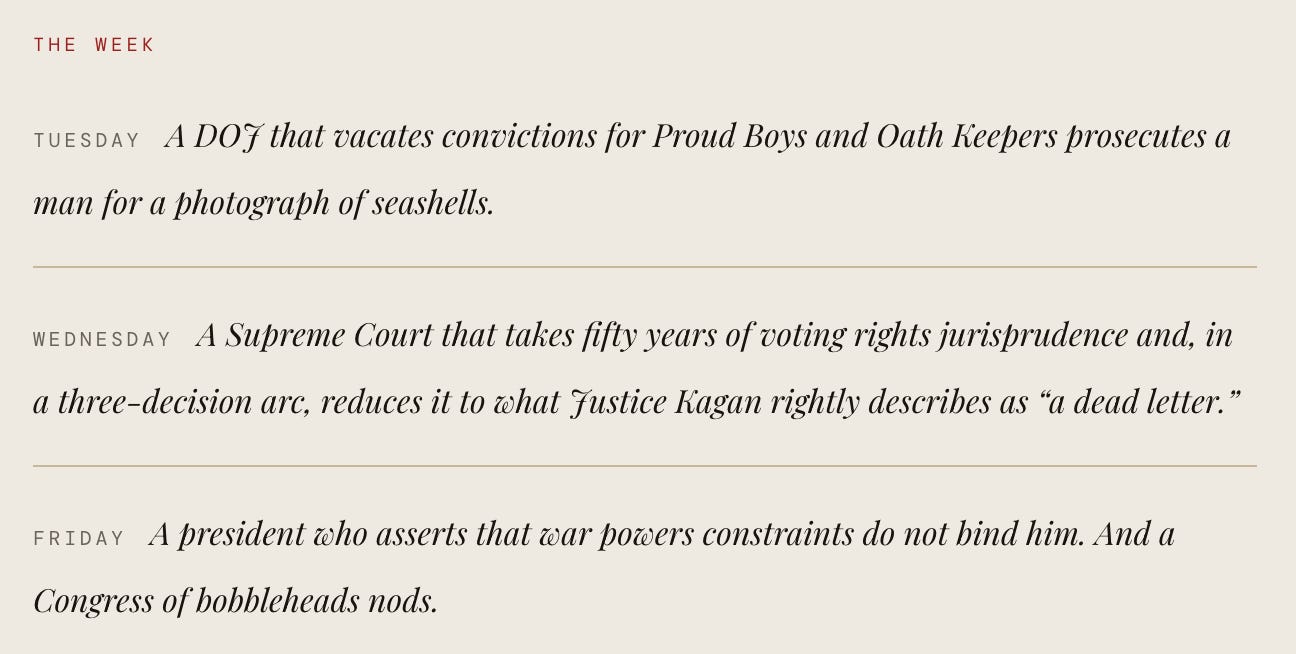
This week is what institutional failure looks like when it happens in all three branches at once.
Tuesday · April 28 · Absurdity
The Seashells Prosecution
On Tuesday, the Department of Justice indicted James Comey — former director of the FBI, fired by Donald Trump in 2017 — for posting a photograph of seashells on a beach. The seashells were arranged to spell “86 47.” Comey’s caption: “Cool shell formation on my beach walk.” The indictment, two pages long, cites no evidence beyond the image.
The government’s theory is that a reasonable person familiar with the circumstances would read a seashell arrangement of “86 47” as a credible threat to kill the 47th president. Merriam-Webster disagrees. So does the American Heritage Dictionary. So does Sen. Thom Tillis (R-NC), who told reporters he had searched to “the end of the internet” and could not find a single example of “86” being used as a violent threat.
The political context is not subtle. Trump has posted about Comey by name more than 250 times. He has called him a “dirty cop,” “a destroyer of lives,” and “one of the worst human beings this Country has ever been exposed to.” A Truth Social post last year, written as though intended for then-AG Pam Bondi, complained explicitly — by name — that Comey had not been prosecuted. Bondi was subsequently fired. Her preferred vehicle, a false-statements case in Virginia, had already been dismissed when a federal judge found the prosecutor unlawfully appointed. Her replacement, acting AG Todd Blanche, accelerated the seashells case within days of taking over. The grand jury indicted on April 28.
The same Department of Justice that has been vacating convictions against Proud Boys and Oath Keepers convicted of seditious conspiracy. The same DOJ pursuing the Southern Poverty Law Center. The pattern is not coincidence. It is policy. Retribution is the organizing principle — not rule of law.
I joined Antonia Hylton and Joyce Vance, on The Beat with Ari Melber on Tuesday to discuss the indictment and its implications for the independence of federal prosecution. The full segment is linked here. A shorter clip of my thoughts is below:
Wednesday · April 28 · Tragedy
VRA Demolition Complete
The absurdity of Tuesday’s Comey indictment was followed by the tragedy of the Supreme Court finishing what it started in 2013, the gutting of the landmark Voting Rights Act. In a 6-3 decision in Louisiana v. Callais, the Court effectively nullified Section 2 of the Act — the last remaining nationwide tool for challenging racially discriminatory voting laws — without technically striking it down. Justice Samuel Alito, writing for the majority, called it an “update.” Justice Elena Kagan, in dissent, called it what it was.
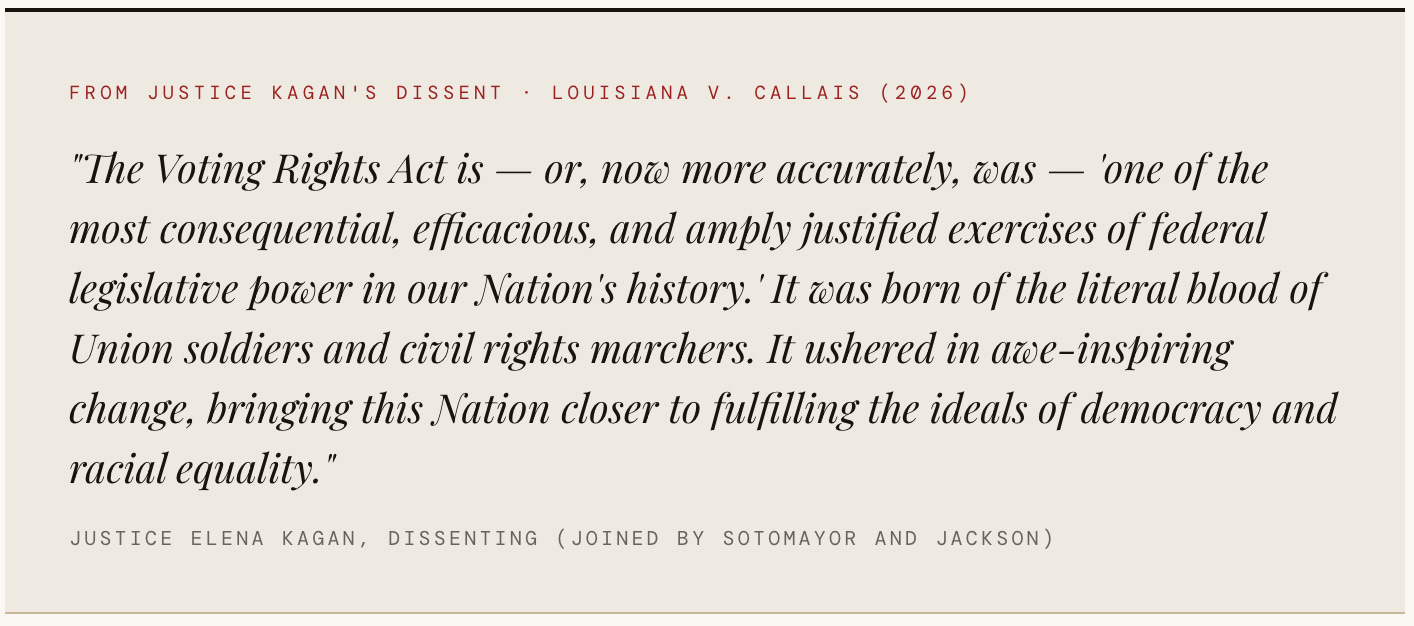
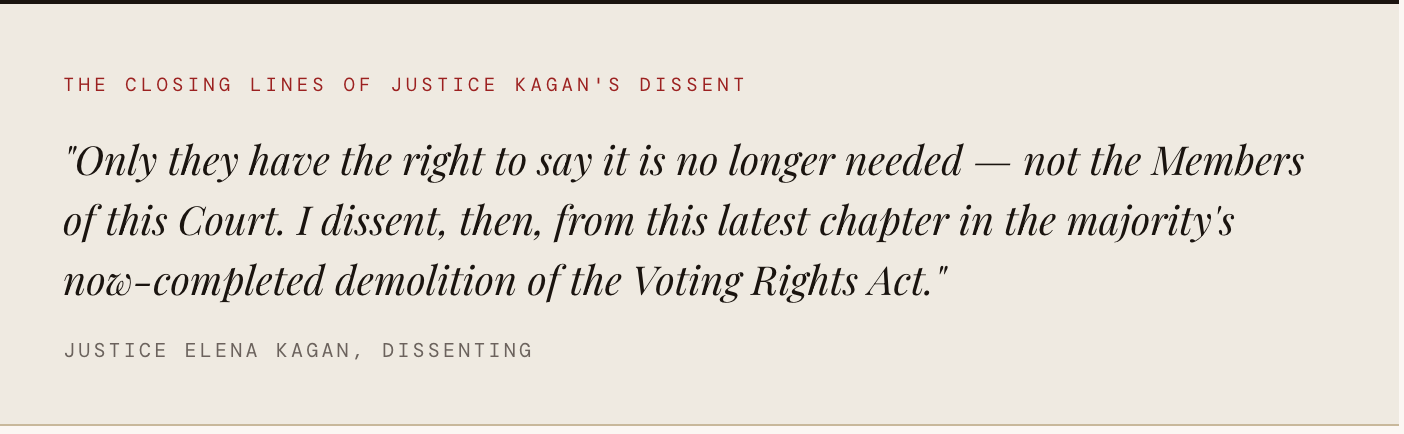
Justice Kagan read portions of her 48-page dissent aloud from the bench — a rare signal of profound disagreement. She omitted the traditional word “respectfully” from her conclusion, writing only: “I dissent.” Her final lines: “I dissent because Congress elected otherwise. I dissent because the Court betrays its duty to faithfully implement the great statute Congress wrote. I dissent because the Court’s decision will set back the foundational right Congress granted of racial equality in electoral opportunity. I dissent.”
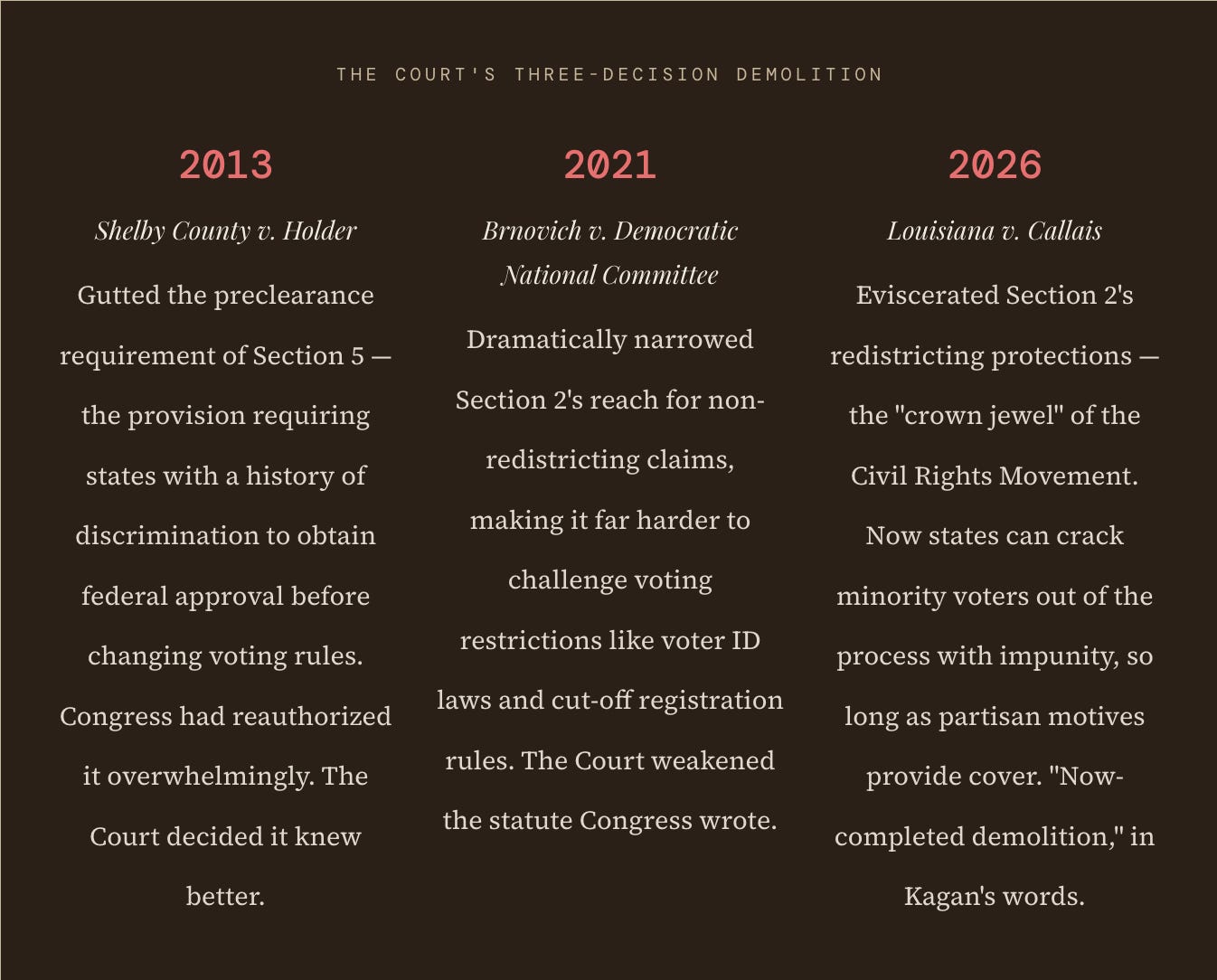
This is, at its core, a quintessential Who Decides Who Decides? question — and the Constitution had already answered it. Let me say that again: The Constitution had already answered the Who Decides question. But the Court majority thinks it knows better.
The Fourteenth and Fifteenth Amendments, ratified in the wake of the Civil War, gave Congress explicit, heightened enforcement powers over race and voting. But in Shelby County in 2013, the Court’s majority decided it knew better than Congress. Accordingly, in a 5-4 decision, the Court eliminated the “before” part of the Act — “preclearance” requirements for jurisdictions with a history of discriminatory voting practices. The Court decided it could decide. It did so again in Brnovich in 2021. And it did so again on Wednesday in Callais. Three legs of the same stool. A before leg (Shelby County); an after leg (Brnovich); and a redistricting leg (Callais).
I was privileged to join two stalwarts of ABC News, Kyra Phillips and Devin Dwyer, on Wednesday in a live, special report discussing the ruling’s meaning and consequences. The full report is available here. A shorter clip is below:
Later that evening, I joined Nicolle Wallace on Deadline: White House for a broader conversation about what Wednesday's ruling means for American democracy.
The best contributions in that segment, by far, were—I can assure you—not from me, but from two intellectual powerhouses who spoke from deeply personal experience: Eddie Glaude and Michelle Norris.
Their commentary grounded the legal discussion in lived reality — a reminder that these cases are not academic exercises. The cases are about whether specific human beings will be able to participate meaningfully in the democracy they were promised.
You can watch the full segment here (and I recommend it so as to hear Michelle’s words). But if you watch only one clip, watch this particular “Instagram” clip of Eddie Glaude. I had a lump in my throat and actual goosebumps listening to him in person. I’ve watched the clip several times since. If you don’t feel while listening this; if you think the lived experience he describes is copacetic, check yourself.
Friday · May 1 · Acquiescence
The Clock Runs Out.
On Friday, the sixty-day clock under the War Powers Resolution expired. The law is clear: absent a congressional declaration of war, a specific authorization for the use of military force, or an extension by law, the president is required to terminate hostilities against Iran.
The Trump administration’s response, communicated to Congress on May 1, was twofold: the ceasefire that began April 7 terminated the hostilities, so the clock has already run; and in any event, the War Powers Resolution is unconstitutional.
The first argument is nonsensical. It would allow a president to treat strategic pauses as the bases for perpetual, seriatim 59-day hostilities indefinitely. That’s not a limit.
The second argument is Nixon’s argument — the one he made when he vetoed the WPR in 1973 (it eventually passed via overriding his veto). Every president since Nixon has preserved the constitutional objection by filing reports “consistent with” the resolution rather than “pursuant to” it. This president has gone further, stating the objection outright as a basis for non-compliance.
“As we sit here today, Iran’s nuclear program is exactly what it was before this war started. They have not lost their capacity to inflict pain. They still have a ballistic missile program. They’re still able to blockade the Strait of Hormuz.”
— Rep. Adam Smith (D-WA), Ranking Member, House Armed Services Committee
Several Republican senators — Collins, Curtis, Hawley — went on record before the deadline saying the WPR must be followed, that 60 days means 60 days, that the statute is “not a suggestion.”
Now the deadline has passed, the administration has formally defied it, and the question is whether those statements will be followed by action. History is not encouraging. Congress has never successfully used the War Powers Resolution to end a military campaign.
The deeper issue is the one that runs through this entire week. This is an administration, with an acquiescent Congress, and a mission-driven Supreme Court, that has decided that the law — the VRA, the WPR, the independence of the Department of Justice — applies when convenient and not otherwise.
I discussed the WPR deadline; the bipartisan reality of Presidents from both parties falling in love with executive powers, and what comes next in this segment with Chris Jansing Friday.
Four days. Three branches.
(1) Tuesday. A DOJ that vacates convictions for Proud Boys and Oath Keepers prosecutes a man for a photograph of seashells.
(2) Wednesday. A Supreme Court that takes fifty years of voting rights jurisprudence and, in a three-decision arc, reduces it to what Justice Kagan rightly describes as “a dead letter.”
(3) Friday. A president who asserts that a statute limiting his war powers does not bind him. And a Congress of nodding bobbleheads performs as a Congress of nodding bobbleheads does.
Institutions are not buildings. They are habits of mind, accumulated over time, that allow a society to govern itself by rules rather than by force or caprice. When institutions fail us — not by accident but by complacency or by design — the damage compounds.
This week offered three examples. There will be more.
I’m glad you’re here. I’m grateful you’re engaged. Here and everywhere.
— James
My first thought when I was the numbers was “Hey someone put their birthday August 6, 1947 into the shape of numbers used with seashells.