
Press Freedom Is Security
A gifted plane, federal agents on reporters' doorsteps, and the vague little word that has quietly become the government's master key.


“The word ‘security,’ is a broad, vague generality whose contours should not be invoked to abrogate the fundamental law embodied in the First Amendment.”
- Justice Hugo Black, concurring in New York Times Co. v. United States (1971)
Start with the plane.
The new Air Force One is a 747 that Qatar gave to the president, retrofitted in a hurry because he had complained that the old one wasn’t impressive enough. He wanted, in his words, a level of luxury nobody had ever seen before. Last week it carried him to a NATO summit in Turkey, which shares a border with a country the United States was, that same week, actively bombing.
And then, quietly, at the Secret Service’s insistence, the president left Turkey on the old plane instead. The New York Times reported why: the gifted jet, rushed into service, does not carry the antimissile countermeasures the older aircraft did. A former Air Force secretary put it plainly — with the Iran situation, he said, he was surprised to see that plane flown outside the United States at all.
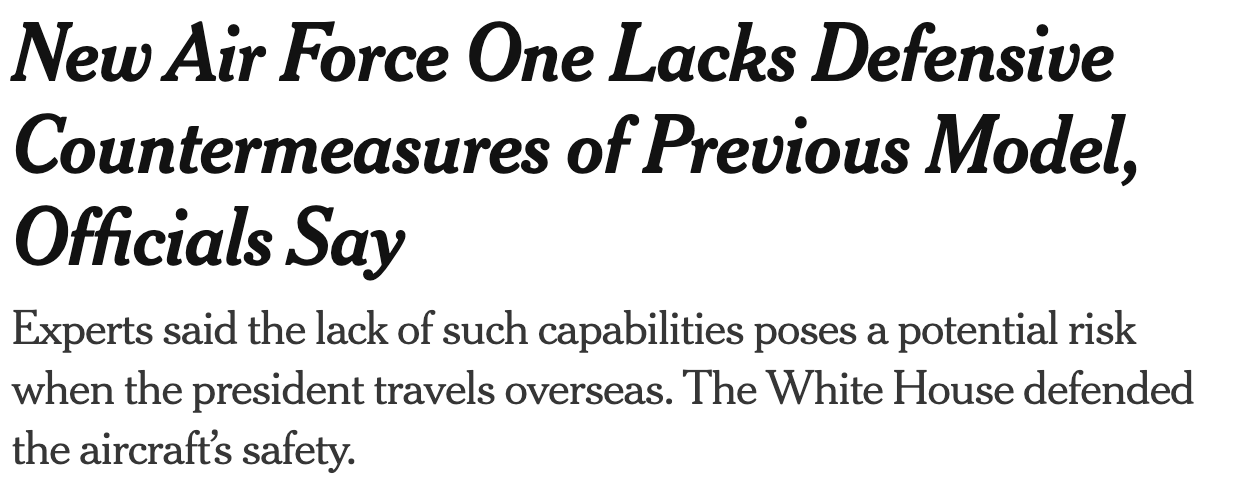
The gift was never actually free. Political gifts rarely are. The Air Force pegged the retrofit at just under $400 million; independent estimates run far higher, and that is before the cost of sweeping a foreign government’s jet for the risks baked into it. Nothing given to a head of state — least of all a transactional one — is ever truly free to the country that takes it. It is why the Emoluments Clauses exist, however reluctant the Supreme Court has been to give them teeth.
The White House’s explanation for the plane swap was that the magnificent new jet needed to peel off early to show itself to the troops. Its explanation for the reporting was more revealing. “We use every tool at our disposal,” the communications director said, “to address those threats.”
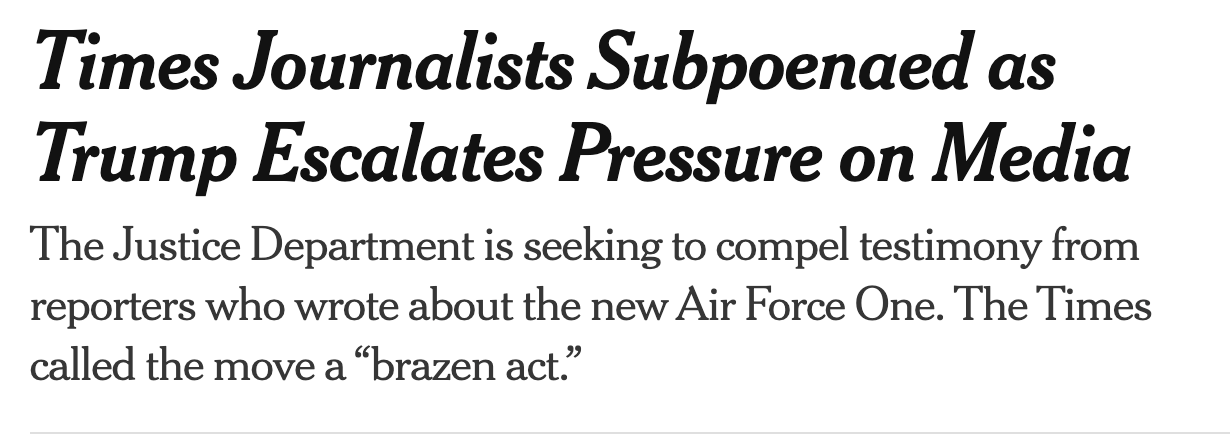
Within forty-eight hours, we learned what “every tool” now includes. The Justice Department served four Times reporters — Julian Barnes, Eric Lipton, Tyler Pager, Eric Schmitt — with subpoenas to testify before a grand jury in Manhattan, and in some cases sent federal agents to hand them over at the reporters’ homes. The subpoenas said only that the testimony concerned “an alleged violation of federal criminal law.” No theory. No named target. Just a command to appear, and the message underneath it, unmistakable: tell us who talked to you.
The Times’s top newsroom lawyer, David McCraw, said the appearance of federal law-enforcement agents on the doorstep of reporters “should shock the conscience of any American who believes in the Constitution and the press freedom it protects.”
The reporters are almost certainly not the target. You cannot, in this country, punish a newspaper for publishing truthful information about a matter of public concern. That fight was settled in 1971, when the government went to court to stop publication of the Pentagon Papers and lost. Prior restraint, the Supreme Court said, carries a heavy presumption against it, and a vague invocation of national security does not overcome it.
So the government adapts. It can ask a paper to hold a story — as the FBI did here, before this one ran — but it cannot force the presses to stop. What it can do is let the story run, and then go looking for the source.
That is what a grand-jury subpoena to a reporter is for. It is not an argument about what was printed; it is a lever to reach the person who talked. And the reason it is so much more dangerous than a lawsuit is that its damage is done whether or not anyone is ever convicted, whether or not the reporters ever say a single word.
The Chill
Lawyers call this the chilling effect, and it is not a figure of speech. The next official who sees something wrong inside the government — a corner cut, a plane rushed, a dollar misspent — now has to weigh whether a phone call to a reporter is worth a federal agent at their own front door. Most will decide that it isn’t. The story you never get to read is the byproduct.
“Security” As Talisman?
Notice the word doing all the lifting. Security.
The reporting was about a plane’s security. The subpoenas are said to protect national security. Before the first story ran, a senior FBI official called a Times editor and asked that it be held — a matter of security, he said, though he declined to say how or why. The word turns up at every step; at every step it is asked to justify the next intrusion; and at no step is anyone required to say what it actually means.
Justice Hugo Black saw this coming and warned against it, in the Pentagon Papers case, in language that reads as though it were written last week. “The word ‘security,’” he wrote, “is a broad, vague generality whose contours should not be invoked to abrogate the fundamental law embodied in the First Amendment.” Black was writing about prior restraints. But his insight was larger, and it is the one this whole moment turns on: a word that can mean anything can be made to justify anything. Security is such a word. So is threat. So, it turns out, is 86.
This is a method: take a capacious word, resolve its ambiguity against the speaker, and let the process do the punishing. And security is the favorite talisman — the word reached for again and again to sanctify the next intrusion.
A dawn search. In January, FBI agents arrived at six in the morning at the Virginia home of Washington Post reporter Hannah Natanson and left with her phone, two laptops, and — a bizarre detail — her fitness watch. The source was already charged; she was accused of nothing. The Department’s own rewritten guidelines permitted a search like this only as a last resort, after other avenues were exhausted. Here it was the first step, not the last — and the word invoked to justify it was, once again, national security.
Seashells. The method is not confined to the press. James Comey, the former FBI director, posted a beach photo of shells arranged to read “86 47,” captioned “Cool shell formation on my beach walk.” The government called it a threat to assassinate the forty-seventh president — insisting that “86,” the word every line cook uses to mean we’re out of it, here meant kill him — and indicted him. A judge in a related case has already called it difficult to fathom how those digits could be a true threat. The prosecution will surely collapse under the weight of its own absurdity. But the year of lawyers and dread between indictment and acquittal is the punishment, and it lands on everyone watching.
“The easy way or the hard way.” The chairman of the FCC, which licenses the airwaves Jimmy Kimmel’s network uses, said exactly that about Kimmel on a podcast. Hours later, Kimmel was off the air. He returned after a backlash the administration hadn’t expected, and he broadcasts today. The show survived. The chill did not lift.
“A big fat bribe.” Days after Stephen Colbert used that phrase for his own corporate parent’s settlement with the president — while that parent awaited the administration’s approval of a merger it badly wanted — CBS canceled his top-rated show and called it “purely financial.” Perhaps it was. We are not permitted to test the claim, and that impossibility is itself the product.
The Courts
The United States is not Hungary. It is not Russia, where “foreign agent” is a label the state staples onto any journalist it dislikes; it is not Serbia. What those places have in common is not censorship in the crude, cinematic sense. It is the legal form of the thing. The instruments are ordinary and lawful-looking one at a time — a licensing rule, a court order, an indictment, a merger held quietly hostage.
And the reason we can write this sentence, and you can read it, without any of us fearing a knock at the door is the part of our system those other countries had to dismantle first: independent courts. The Wall Street Journal and the Washington Post were subpoenaed earlier this year on theories like this one, fought back, and watched the subpoenas withdrawn. The Times has already countersued the administration on a separate front. Kimmel came back. The seashell theory is faring badly with judges. The stories still run. Resistance, here, still works — which is precisely why the moment to insist on it is now, while it still does.
Which returns us, as these things always do, to the question this newsletter is named for. Who decides?
Who decides whether a missing missile-defense system on a gifted plane is a state secret or an embarrassing procurement story?
Who decides whether seashells are a threat?
Who decides whether security — that broad, vague generality — reaches this leak, this reporter, this critic, this joke?
Under our system the answer is supposed to be: not the person with the most to gain from the answer, and never the official who is himself the subject of the story. The whole design of the First Amendment is a refusal to let the government be the judge of what the governed are permitted to know.
And notice what the reporting actually did. Four journalists told the country a fact the government would have preferred buried, and one the public plainly needed.
That is security — the kind that comes from a people able to see their government’s failures in time to insist they be fixed. Black understood the difference. Guarding secrets, he wrote, “at the expense of informed representative government provides no real security for our Republic.”
“The press was to serve the governed, not the governors,” Black wrote in that same opinion. “The Government’s power to censor the press was abolished so that the press would remain forever free to censure the Government.” He was right about the design. Whether it remains the practice is, this summer, an open question — and the answer will be written not by judges alone, but by whether the rest of us are still paying attention.
They are counting on us not to be.
I’m glad you’re here. I’m grateful you’re engaged. Here and everywhere. - James
Great piece, James.
Let's talk here for now