

A note in advance of the article: this piece is a bit longer, and a bit more content-intensive than the general pitch of this newsletter. Today, that’s intentional because it is my view that setting the table with this content, in advance of tonight’s address is important, and worth your time. I hope you agree. I apologize if it’s not to your taste. So, yes, this piece takes some reading. But elevating the discourse — together — is the goal. -JS
Teasing his address to the nation, scheduled for tonight, President Trump stated, “Thursday is, it doesn’t get bigger because without free and fair elections, you don’t have a country.” Trump “is expected to detail information that he has recently received from the Office of the Director of National Intelligence related to the 2020 election.” In other words, from Bill Pulte, whom Trump installed despite the fact—indeed, almost certainly because of the fact—that Pulte has zero national security experience.
Proposals to have the President declare a national emergency and assume control over elections have surfaced repeatedly this year, each resting on a claim of foreign interference in American elections. The specifics vary from one iteration to the next. The constitutional question they raise does not. It is a question about the structure of American government, and the law has had a durable answer to it for more than seventy years.
Begin with a feature of the Constitution that is easy to miss because it is an absence. The document contains no general grant of emergency power. The Framers, who had lived through war and rebellion, understood perfectly well what emergencies were. They provided for a few by name, most notably by allowing Congress to suspend habeas corpus in cases of rebellion or invasion.
Beyond those specific provisions, they declined to write an emergency clause that would let any branch set the ordinary rules aside. That omission was deliberate. They had seen how readily claims of necessity become instruments of power, and they built a government meant to function under law even under strain.
The modern framework for testing executive claims of emergency authority comes from the steel seizure case of 1952. During the Korean War, facing a threatened strike that he believed would cripple wartime production, President Truman ordered the federal government to seize and operate the nation’s steel mills. He pointed to no statute authorizing the seizure. In fact, when Congress had passed the Taft-Hartley Act five years earlier, it had considered giving the President seizure power and had chosen instead a different mechanism, a cooling-off injunction. The Supreme Court held the seizure unconstitutional in Youngstown Sheet & Tube Co. v. Sawyer, and the concurrence that has shaped the law ever since was written by Justice Robert Jackson.
Jackson brought unusual credentials to the question. He had served Franklin Roosevelt as Solicitor General and then as Attorney General, roles in which he had defended broad assertions of presidential power, and he had served at Nuremberg as chief American prosecutor, where he studied at close range how a constitutional republic can be dismantled through emergency decree. He wrote with candor about that experience, observing that the advantages and dangers of sweeping executive power “will impress anyone who has served as legal adviser to a President in time of transition and public anxiety.” He was describing himself, and he was cautioning against the very expansiveness he had once advanced.
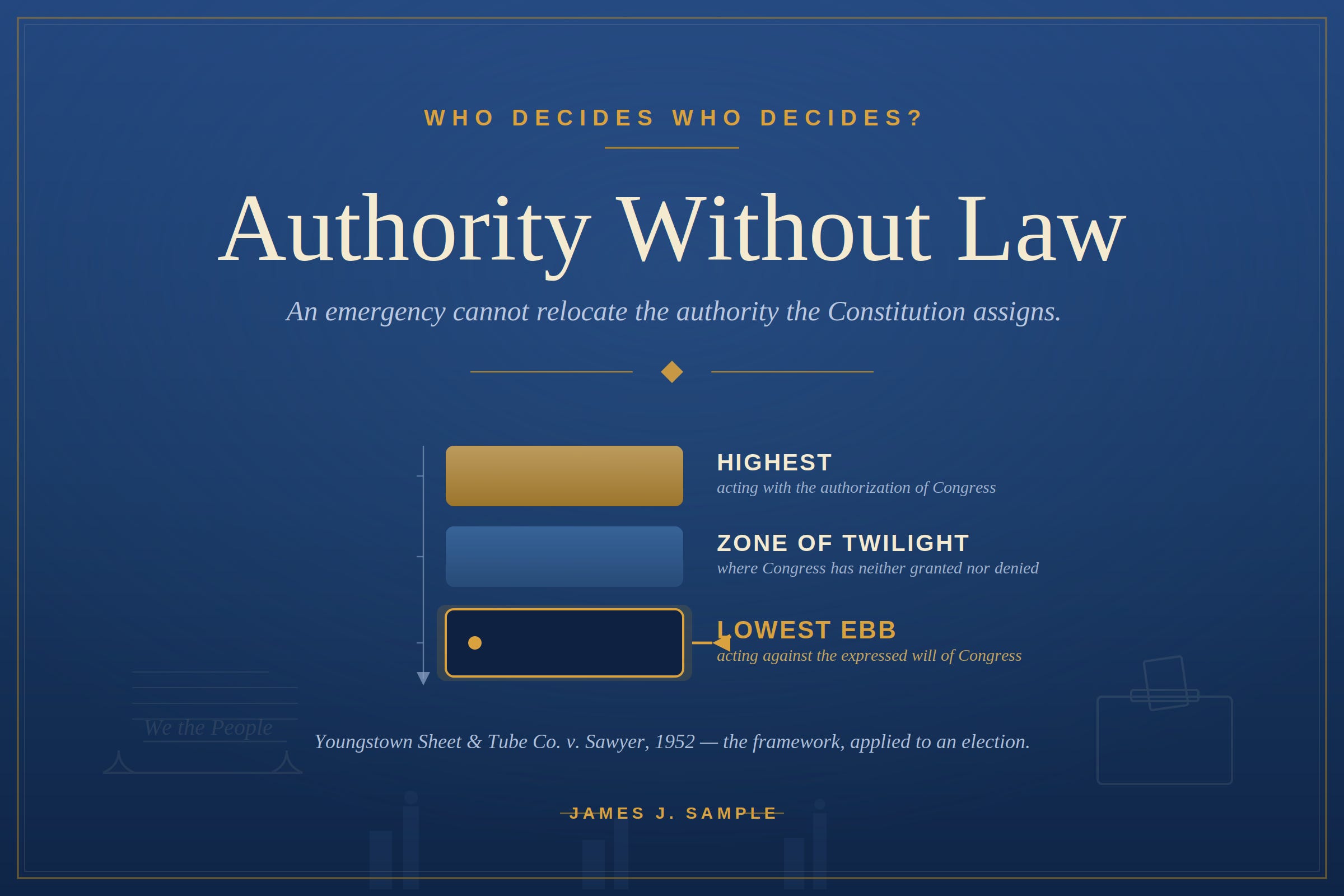
Jackson’s opinion sorted presidential action into three categories, and the sorting turns entirely on the relationship between the President and Congress.
When the President acts with authorization from Congress, his power is at its height, for it combines his own authority with the legislature’s.
When Congress has neither granted nor denied authority, the President acts in what Jackson called a “zone of twilight,” relying on his independent powers in an area of uncertain distribution.
And when the President acts against the expressed or implied will of Congress, his power is “at its lowest ebb, for then he can rely only upon his own constitutional powers minus any constitutional powers of Congress over the matter.”
In that third category, a court can uphold the President only by finding Congress disabled from acting on the subject at all, a claim Jackson said “must be scrutinized with caution, for what is at stake is the equilibrium established by our constitutional system.”
The framework is still binding law. In 1981, in Dames & Moore v. Regan, the Court adopted Jackson’s three categories as the governing analysis for executive-power disputes. The opinion was written by William Rehnquist, who had clerked for Jackson during the steel seizure term and watched the framework take shape. One of Rehnquist’s own clerks in 1981 was John Roberts, now the Chief Justice. The structure Jackson devised is the one the current Court applies.
Apply it to elections, and the analysis is short. The Constitution’s Elections Clause, in Article I, assigns the times, places, and manner of federal elections to the state legislatures, subject to alteration by Congress. The President is not mentioned, and there is no emergency exception.
That is why proposals to impose national voting rules take the form of legislation, such as the SAVE America Act. Legislation is the only lawful route. The National Emergencies Act does not change this. It is a procedural gate rather than a grant of power. It sets out how a President declares an emergency and requires him to name the specific statute he invokes, and that underlying statute supplies whatever authority exists. The statutes typically cited reach nothing close to elections.
The International Emergency Economic Powers Act governs sanctions and foreign-held property, and this February, in Learning Resources v. Trump, the Supreme Court refused to stretch it to tariffs, with the majority reaffirming that the President holds no inherent peacetime authority over powers the Constitution commits to Congress.
The absence of an authorizing statute might, standing alone, leave such an order in the zone of twilight, Jackson’s middle category, where Congress has neither granted nor denied authority and the distribution of power is uncertain. But Congress has not been silent here. It has repeatedly refused to pass the SAVE America Act, the very set of measures such an order would impose, from documentary proof of citizenship to sharp limits on mail voting.
A President who acted anyway would be acting against the expressed will of Congress, doing by decree what the legislature has weighed and declined to enact. That refusal is what places the order in the third and weakest category. It is the same feature that placed the steel seizure there, since Truman acted only after Congress had considered seizure authority in the Taft-Hartley Act and chosen to withhold it.
The current effort makes the posture unusually plain. Its proponents have described, on the record, a plan to assemble a declassified “predicate” first and issue the order after, with a task force gathering documents to fit a conclusion already reached. That sequence inverts what an emergency is.
Justice Jackson anticipated the pattern. The Framers, he wrote, knew that emergencies “afford a ready pretext for usurpation,” and suspected “that emergency powers would tend to kindle emergencies.” Having watched Weimar Germany’s emergency article invoked hundreds of times until rights were suspended for good, he did not treat the danger as abstract.
None of this depends on predicting how a given case would come out. It depends only on the structure the Constitution established and the framework the Court has used to enforce it. The Constitution answered the question of who writes the rules of an American election at the founding, in 1787, when it assigned those rules to the states and to Congress and withheld them from the President.
What the steel seizure case supplied was the framework for testing any claim that an emergency permits the President to act against the will of Congress. Applied here, that framework points in a single direction. An emergency declaration cannot relocate the authority the Constitution assigns.
A President who tried would stand where Truman stood: at the lowest ebb of his power, exercising what Jackson called authority without law.
I’m glad you’re here. I’m grateful you’re engaged. Here and everywhere.
— James
An outstanding analysis, James. Your use of historical context to examine the constitutional boundaries of emergency powers brings clarity to a complex and timely issue. Thoughtful, well-reasoned, and an excellent reminder of why historical perspective remains so valuable in today's legal and civic discussions.