
An Emergency Built to Order
A former Vegas oddsmaker handed the President a fake legal theory for changing the midterm rules. The President said "stranger things have happened." He would know.

If “Real America’s Voice,” is your source for Constitutional Law analysis, caveat emptor. Yesterday, host Wayne Allyn Root told the President how to take over the midterms. The Senate had gone home without passing the SAVE America Act, so Root proposed a workaround. Declare a national security emergency for elections. Photo identification, documentary proof of citizenship, and limits on mail voting follow automatically. No Senate required.
The President did not say no. He said “stranger things have happened.” On that point the President is an authority. The last time he lost a national election, the strange thing that happened was January 6, 2021.
Root is a former Las Vegas oddsmaker and the Libertarian Party’s 2008 nominee for Vice President. His day job is chief executive of Winners, Inc., a sports-betting penny stock. His qualification to opine on the separation of powers is roughly the Pillow Guy’s qualification to audit a voting machine, and the “analysis” he delivered is of comparable quality.
What makes the “analysis” worth your time, dear reader, is that the President of the United States received it as a suggestion worth considering, on the air, eighty-three days before a national election.
The plan is old. The citation is new.
I wrote here a month ago about why an emergency declaration cannot move authority over American elections from the states and Congress to the President, and I went through it on air, in some detail, with Katy Tur.
None of this is improvisation. The leaked seventeen-page draft order has been in circulation for the better part of a year, assembled in consultation with outside election-denial activists, and the Center for American Progress walked through its cited authorities in March: the National Emergencies Act, the Defense Production Act, a statute about federal holidays. The draft would force all 211 million registered Americans to re-register in person, with a birth certificate or passport, before November. Its proponents have described their sequence on the record, which is to assemble a declassified “predicate” first and issue the order afterward, with a task force gathering documents to support a conclusion already reached.
That is an emergency built to order. What Root added Tuesday was a case name, albeit one that, at best, is a non sequitur.
Keep your feet grounded
Root told the President that the Supreme Court settled this in 1983, in INS v. Chadha, and that under Chadha an emergency declaration cannot be challenged in court and can be undone only by two-thirds of both houses of Congress.
My friend Rick Hasen answered within hours. Hasen is the gold standard in election law, and his ordinary register is measured. He does not often reach for the word ridiculous. He reached for it Tuesday:
This is ridiculous and people should not panic over it. The President has no role to play in running elections . . . Calling it a “national emergency” doesn’t change things. There’s no part of the Constitution or federal law that would give the President power to say how states run their mail ballot programs, voter id, etc.
Courts have made that point repeatedly in the litigation over the President’s two elections orders. Hasen’s closing advice ran to four words: keep your feet grounded.
Hasen notes that these claims circulate because they pay in several currencies at once.
They frighten people about whether their votes will count, which keeps some of them home.
They lay track for treating a defeat as a theft.
They raise money for the people making them.
Cleta Mitchell floated a version of this fever dream two years ago. Hasen’s greater worry sits downstream of Election Day, in what an administration might attempt with tabulation and certification if a chamber turns on a narrow margin.
Joyce Vance, writing Tuesday night, had a different tone and she is also right. Her thesis: treating the exchange as bluster misreads the record. This President declined to commit to honoring the result in 2016, declined again in 2020, and we learned what the second refusal was worth.
Both propositions apply at once. The legal theory is empty. The intent behind repeating it is not.
The courts answered the same day
While Root was blathering, Judge Indira Talwani was in Boston, doing actual legal analysis.
She entered a nationwide injunction barring the Postal Service from implementing Section 3 of Executive Order 14399, the March order on citizenship verification in federal elections, whose third section directs the Postal Service to withhold mail ballots from voters missing from a federally compiled list. The executive branch, she wrote, has no authority to regulate elections. With fewer than ninety days to November 3, rewriting the rules now is intolerable.
The government is not defending the order’s constitutionality. Its position is that the courts should wait, because the Postal Service has not issued a final rule yet. Three courts, two elections orders, and the administration’s argument is about timing.
So much for the proposition that a declaration cannot be challenged.
Where a President stands when Congress has said no
The framework for testing any claim of emergency authority comes from the steel seizure case, and it does not favor the President here.
As I discuss in the above clip with Katy Tur, in 1952, Truman seized the nation’s steel mills during the Korean War, pointing to no statute. Congress had considered giving Presidents seizure power in the Taft-Hartley Act five years earlier and had chosen a cooling-off injunction instead. The Court held the seizure unconstitutional, and Justice Robert Jackson’s concurrence became the governing analysis, adopted by the Court in Dames & Moore v. Regan in 1981 in an opinion by William Rehnquist, who had clerked for Jackson during the steel seizure term. One of Rehnquist’s clerks that year? John Roberts.
Jackson sorted presidential action into three categories, and the sorting turns entirely on the relationship between the President and Congress.
Highest. The President’s own authority plus the legislature’s, and a court will sustain it absent some constraint on the federal government as a whole.
Zone of twilight. Independent presidential power, in an area where the distribution of authority is uncertain and practice matters more than doctrine.
Lowest ebb. The President’s own constitutional powers minus whatever Congress holds over the subject. A court can sustain him only by finding Congress disabled from acting on the matter at all.
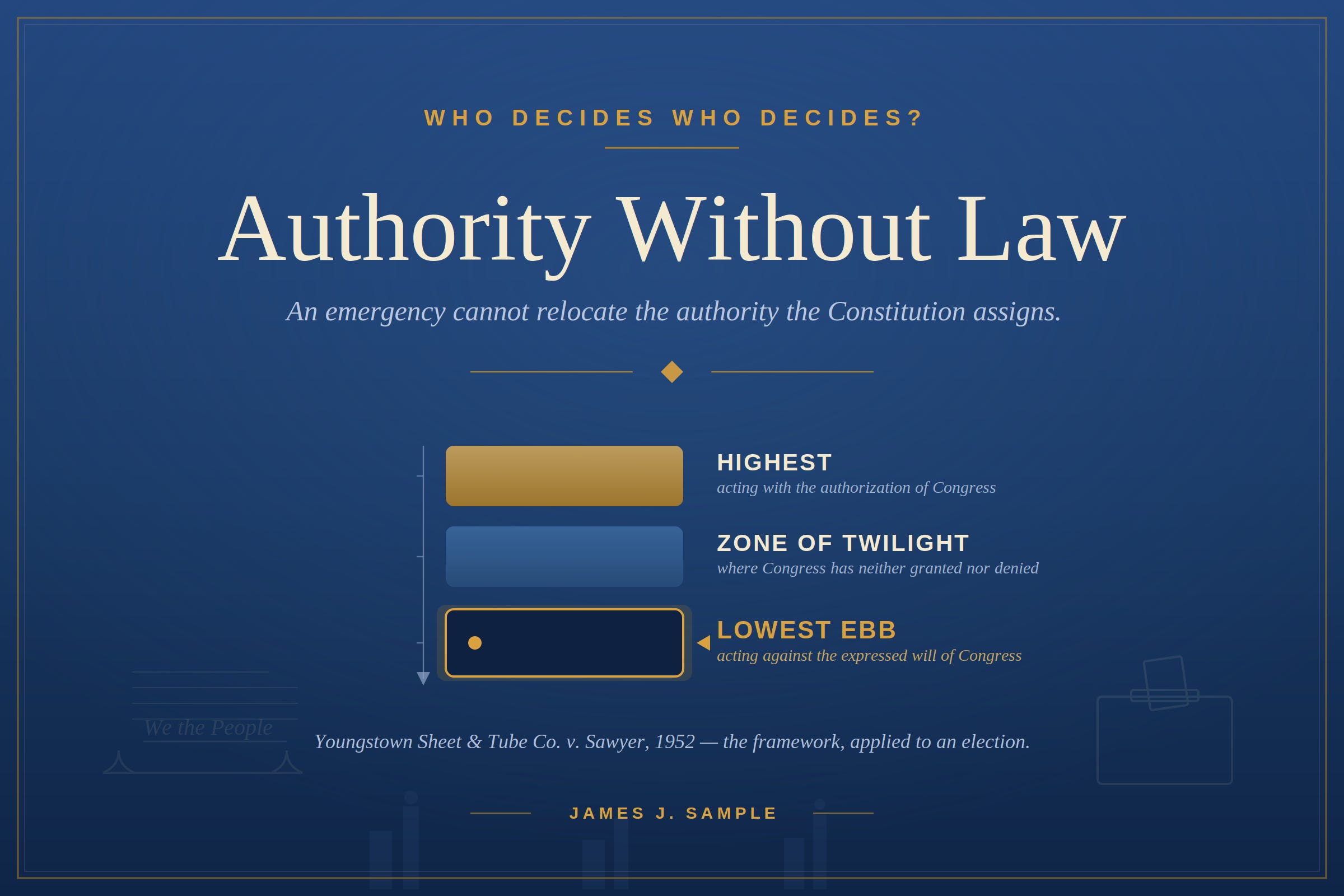
The above graphic ran here last month. It earns a second run today.
Getting a case into that third category ordinarily takes litigation. Someone has to prove Congress weighed the power and withheld it.
Root unintentionally proved it on the radio. His stated premise was that the Senate is in recess and will not pass the SAVE America Act. The emergency he described is Congress declining to act, offered out loud as the reason for the decree. Truman never had the nerve to say that the point of the seizure was to get what Taft-Hartley denied him.
Jackson, who had defended broad executive power as Roosevelt’s Attorney General and then prosecuted at Nuremberg, wrote that emergency powers tend to kindle emergencies. He had watched Weimar’s emergency article invoked into a permanent condition. A President who did what Root suggests would be exercising what Jackson called authority without law.
A switch, not a source
The National Emergencies Act is a switch, not a source. A declaration creates no power. It turns on statutory authorities Congress has already written and left dormant, roughly 130 of them scattered through the U.S. Code, and the President still has to satisfy each statute’s own terms once the switch is thrown. Mark Nevitt of Emory Law has catalogued what those authorities actually cover: sanctions, military construction, communications, the machinery of foreign affairs and national defense.
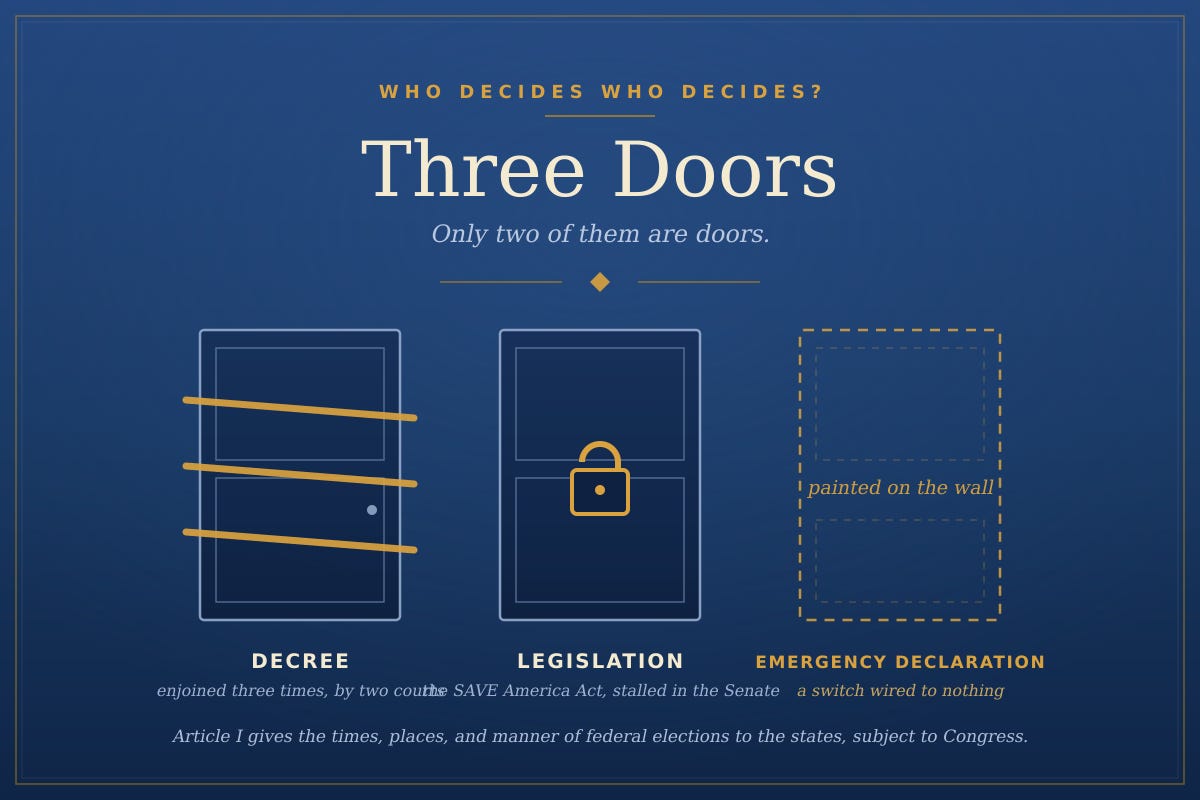
Not one of them touches the administration of elections, because Congress never handed that authority over and could not have handed over what the Constitution gives the states. Article I assigns the times, places, and manner of congressional elections to the state legislatures, subject to alteration by Congress. The President is not in the clause. There is no dormant election statute waiting to be activated, which means the switch is not wired to anything.
Three routes exist for a President who wants national voting rules, and all three are on the board right now. Decree, enjoined three times by two courts. Legislation, which is what the SAVE America Act is, and whose failure in the Senate is the premise of Root’s pitch. Emergency declaration, the weakest of the three, because it is not a route at all.
Grading the answer
The case Root named, Chadha, held that a single house of Congress could not veto an executive branch decision, because Congress acts with the force of law only by passing a bill through both chambers and presenting it to the President. Congress had written that shortcut into the immigration statute itself, deliberately, for reasons it thought sound. The Court voided it.
I practiced election law for many years, and have graded constitutional law exams for the better part of two decades. Root’s answer contains three propositions.
1. “they can’t challenge it”
Chadha is a case in which a court reviewed governmental action and struck it down. The student cites, as authority for unreviewability, an exercise of judicial review. No credit.
2. “only be overturned by a two-thirds vote of both houses”
Accurate, and arrived at by accident. The National Emergencies Act as passed in 1976 let both houses end an emergency by concurrent resolution, with no presentment. Chadha killed that off switch, and in 1985 Congress substituted a joint resolution, which the President can veto, which is why overriding him now takes two-thirds. What the student has identified is a limit on Congress. He has written it down as a power of the President. Partial credit, for the fact, not the reasoning.
3. “you don’t even need the Senate’s vote”
Chadha holds that a branch of government may not route around the channels the Constitution prescribes, not even a route it wrote for itself. The proposition drawn from it is that the President may route around Congress entirely. No credit, and see me after class.
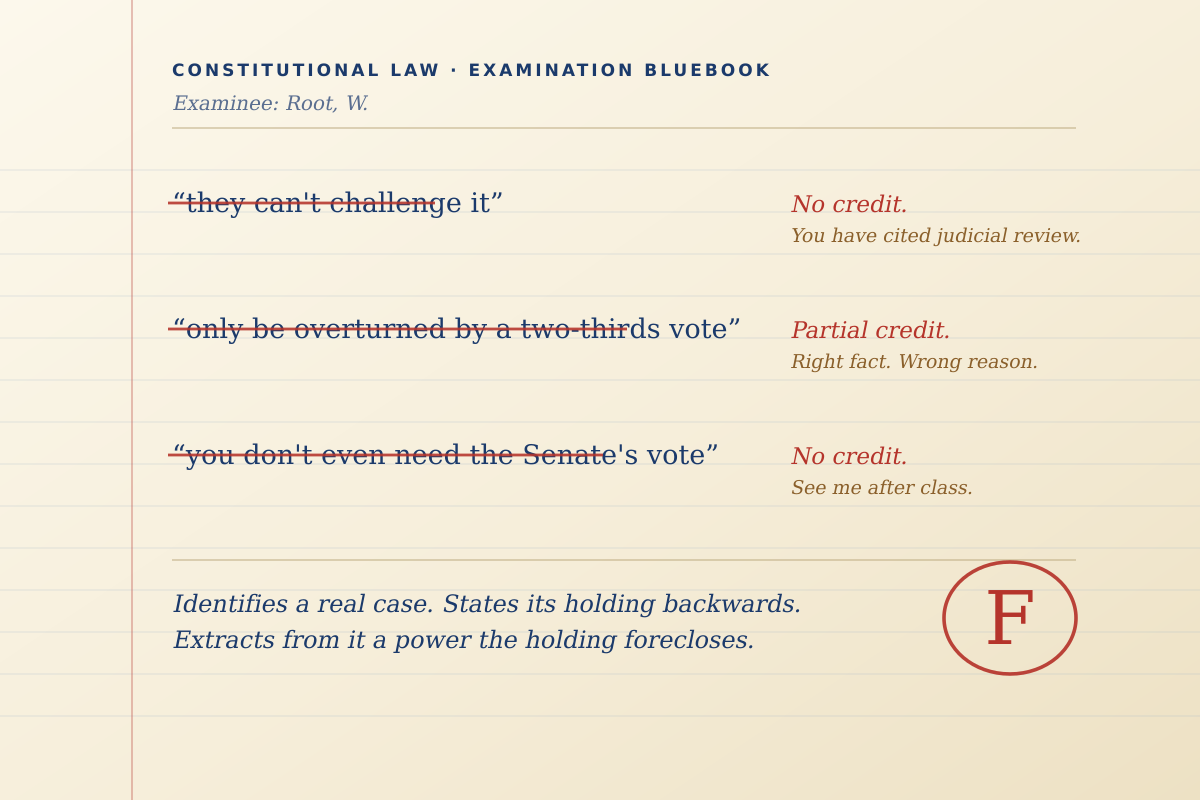
The answer identifies a real case, states its holding backwards, and extracts from it a power the holding forecloses. It would fail a first-year course. It did not have to survive a first-year course. It had to survive four minutes of morning radio and land on a President who said stranger things have happened.
TLDR: Root’s citation indicts Root’s “plan.”
What deserves the worry
An emergency assembled around a manufactured predicate, and effectively impossible for Congress to switch off, is dangerous wherever it eventually points. That is the real lesson of Chadha for this moment, and nobody on Real America’s Voice mentioned it.
The nearer danger was never the proclamation. It is counting and certifying, in a handful of counties, if control of a chamber comes down to a margin thin enough to litigate.
The Constitution answered the question of who writes the rules of an American election in 1787, by giving the answer to the states and to Congress and withholding it from the President. No declaration relocates that. A President who tried would stand exactly where Truman stood, at the lowest ebb, holding a switch wired to nothing, with a case citation that says the opposite of what he needs it to say.
I’m glad you’re here. I’m grateful you’re engaged. Here and everywhere. — James
We the people will need to stay very steady and determined to have peaceful elections, to get out the vote, and be prepared to demand recounts.