


The Supreme Court’s October Term 2025 is almost over, and several of its most closely watched cases are still outstanding.
As of now, the Court has set opinion days for this Tuesday and Thursday. That schedule can shift, and the justices sometimes carry cases past the term’s nominal end and into July. The presidential-immunity ruling in Trump v. United States, for example, did not arrive until July 1, 2024. Whenever they land, the opinions still to come will make this one of the most consequential terms in memory.
It is worth remembering how much this term has already done.
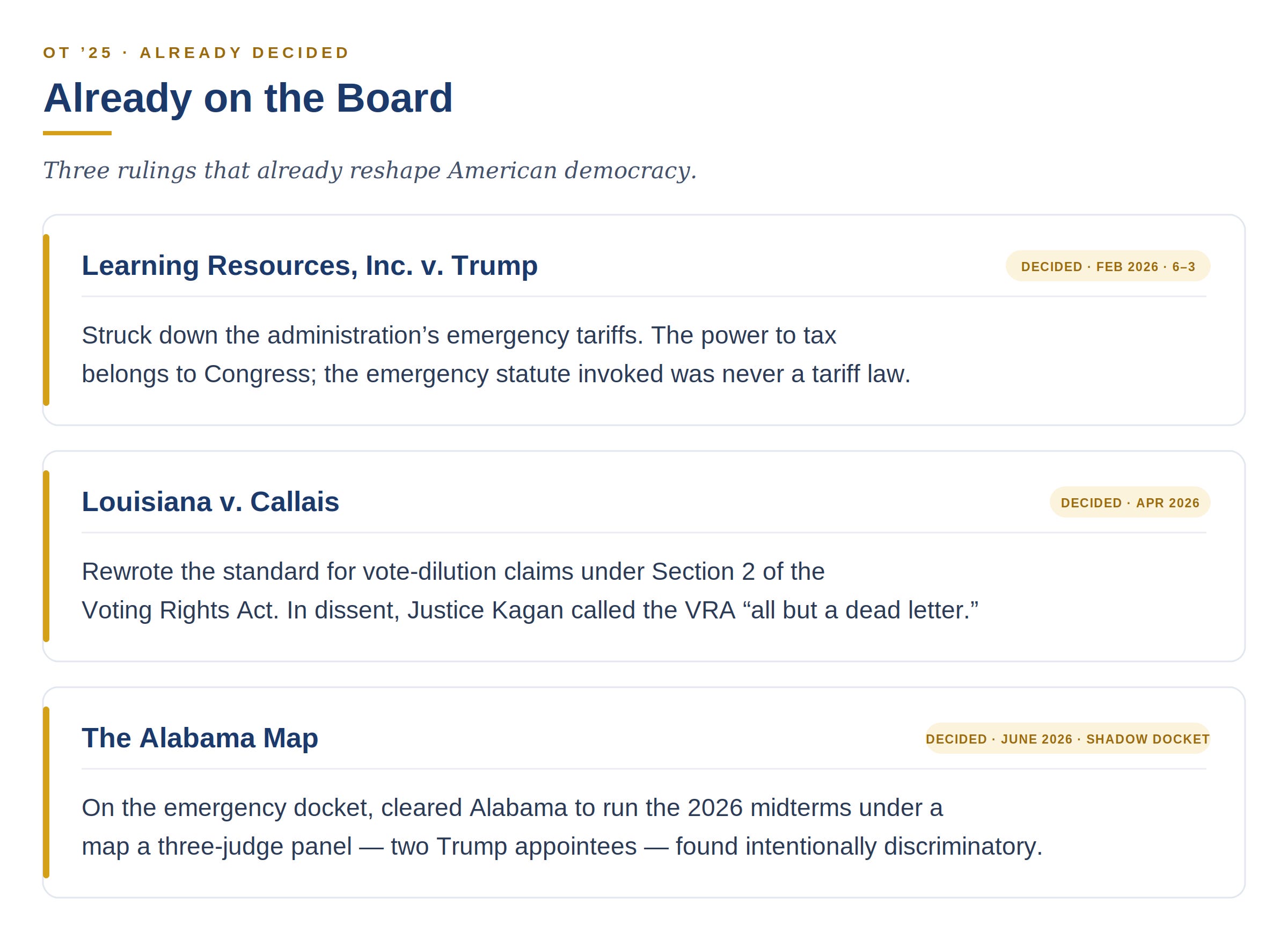
Those cases are settled. Each is historic. What follows is what the Court still holds in its hands.

Who is a citizen? — Trump v. Barbara
The Court will decide whether a president can deny birthright citizenship, by executive order, to children born on U.S. soil whose parents are neither citizens nor lawful permanent residents. The Fourteenth Amendment’s text, the Court’s 1898 decision in United States v. Wong Kim Ark, and more than a century of unbroken practice all point one way. At argument on April 1, which President Trump attended in person, justices across the bench struggled to find a limiting principle in the government’s theory. I previewed the case in full in A Birthright Citizenship Tale of the Tape. The stakes are as elemental as any the Court decides: who counts as an American.
Who runs the government? — Trump v. Slaughter
This is the most important case most people have never heard of. The Court is weighing whether the President may remove the commissioners of independent agencies at will, and whether to overrule Humphrey’s Executor, the 1935 precedent that has protected the independence of bodies like the SEC, the National Labor Relations Board, the Federal Election Commission, and the Federal Trade Commission for ninety years. A ruling for the President would leave those agencies in place while hollowing out their independence, making their fidelity to the law turn on the disposition of whoever occupies the Oval Office.
One detail to watch sits just outside this case: whether the Court shields the Federal Reserve from the same logic. That question runs through a separate dispute, Trump v. Cook, over the administration’s attempt to remove Fed Governor Lisa Cook. A carve-out for the Fed would signal that even the justices grasp how radical the broader logic is.
Whose ballot counts? — Watson v. Republican National Committee
Many states count mail ballots that are postmarked by Election Day and arrive a few days later. The Court will decide whether federal law forbids the practice, whether a ballot cast on time may be discarded because the Postal Service delivered it late. A ruling against the grace period could reach as many as fourteen states and millions of voters, including the roughly four million military and overseas Americans who rely on those extra days most. I broke the case down, flowcharts and all, in Mail-in Ballots: Flowcharting the Supreme Court’s Choose-Your-Own-Misadventure.

The democracy cases above are the heart of the term, and of this newsletter. Two other pending cases deserve a word as the opinions come down.
On April 29, the same morning Callais came down and buried them in the day’s coverage, the Court heard a pair of consolidated Temporary Protected Status cases — Mullin v. Doe (Syria) and Trump v. Miot (Haiti). They ask whether the administration can end the protections that roughly 350,000 Haitians and several thousand Syrians rely on to live and work here legally, and whether courts may review that choice at all. The government calls the Homeland Security Secretary’s discretion effectively unreviewable; the challengers say the Secretary must at least follow the procedures Congress wrote.
The challengers also press a constitutional claim: that the terminations sprang from racial animus rather than the statutory process. A federal judge found the Haiti decision likely tainted by such animus, and Justice Sotomayor called the President’s denigration of Haitians a “prime example” of discriminatory purpose.
In West Virginia v. B.P.J. and Little v. Hecox, argued January 13, the Court will decide whether states may bar transgender girls from girls’ and women’s school sports, under Title IX and the Equal Protection Clause. Idaho and West Virginia assign teams by sex at birth; two transgender students challenged the bans and won in the Ninth and Fourth Circuits before the states appealed.
The athletes invoke the sex-discrimination reasoning of Bostock v. Clayton County (2020); the states cite fairness, safety, and the judgment of legislatures over courts. Twenty-nine states now have such bans. My friend Devin Dwyer has an outstanding video story that humanizes both the stakes and the competing perspectives.

Set the three democracy cases side by side and the same question runs through them, who decides?. Who decides who is a citizen? Who decides whether independent agencies answer to statutory schemes or to the President? Who decides whether a timely ballot counts?
The home stretch of a blockbuster term starts now.
I’m glad you’re here. I’m grateful you’re engaged. Here and everywhere. — James