
Trump's Election Speech: A Day After Q&A
Misleading claims vs. real laws, contrary data, and serious dangers.

1. The predicate.
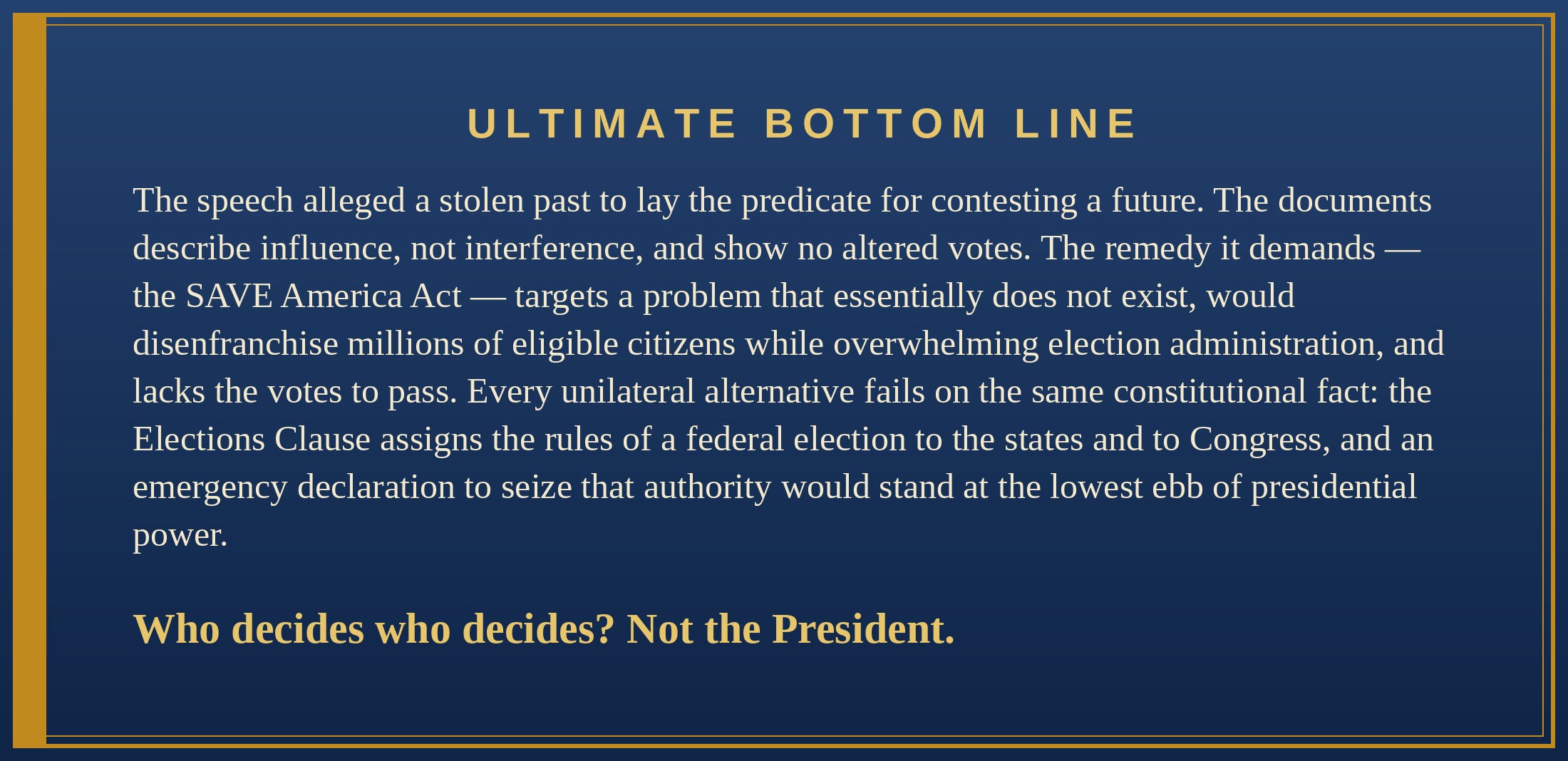
The address is best understood not as a claim about 2020 but as a predicate for 2026.
The stated grievance is the past election. The operative demand is forward-looking: pass the SAVE America Act, and, failing that, act by executive order.
The pieces move concurrently and all point at election administration: the speech; the SAVE America Act; the voter-roll litigation and NVRA quiet-period reinterpretation; newly announced federal investigations; and the threatened executive order.
Peter Baker (NYT) reports the through-line as laying a predicate to contest a loss before it happens — the strategy analyzed previously in this space in The Verdict Before the Vote.
2. Who sets the rules of a federal election. (The controlling question.)
Article I, § 4 — the Elections Clause: the times, places, and manner of federal elections “shall be prescribed in each State by the Legislature thereof,” subject to alteration by Congress.
The allocation is exhaustive: states legislate; Congress may override; the President is not named.
No enumerated executive authority over election conduct. No residual power. No emergency exception.
The omission is deliberate. The Framers did not let the person standing for reelection write the rules of the election.
Two consequences govern everything below.
Any federal change to election rules must come through legislation — which is why the SAVE America Act exists as a bill.
What Congress may do by statute, the President may not do by decree. The absence of presidential authority is the design, not a gap.
3. The SAVE America Act — the in-person requirement and the administrative collapse.
The Act is the fulcrum: what the speech asks the public to demand of Congress, and what the President has said he will attempt unilaterally if Congress declines. It would require documentary proof of citizenship — for most people a passport or certified birth certificate — presented in person to register or re-register. (Center for American Progress; Vote.org)
The in-person requirement is the core disruption, not a formality.
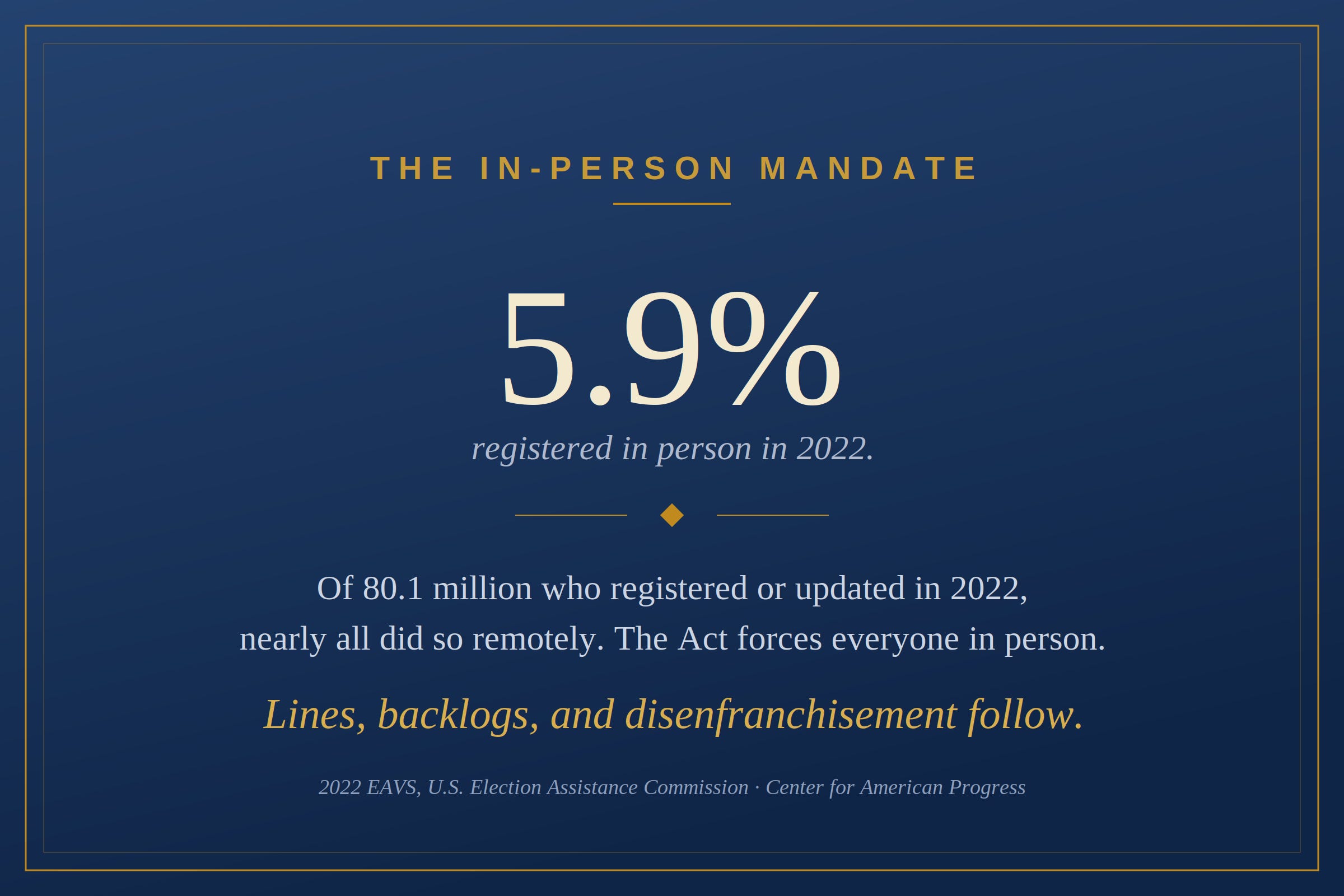
Registration today is overwhelmingly remote and continuous — online, by mail, and at motor-vehicles agencies. Of the 80.1 million Americans who registered or updated their registration in the 2022 cycle, only 5.9% did so in person at an election office. (CAP, citing the EAC’s 2022 survey)
Online registration, which 42 states rely on, would be upended or eliminated (8 million used it in 2022). Mail registration would end (3 million in 2022). Automatic registration through motor-vehicles agencies would be gutted. (CAP)
The Act would route the country’s entire registration volume — nearly all of it now handled remotely — through physical election offices resourced for a fraction of it. The foreseeable result: tens of millions of citizens in line to update a registration every cycle, and election offices overwhelmed. (CAP)
It reaches tens of millions of already-registered voters.
The requirement applies to any registration update, not only new registrations. Moving to a new apartment, moving down the block, changing a name, or changing party each triggers it. (CAP; Rock the Vote)
Every affected voter would have to appear in person with original or certified documents to remain eligible.
Voter-registration drives end.
Drives depend on reaching people where no one carries a passport or birth certificate, and no one will surrender original citizenship documents to a volunteer. The requirement makes them inoperative. Rural Americans, who face the longest travel to an election office, are hit hardest. (CAP; Rock the Vote)
→ The disenfranchisement operates through friction, not any express denial of the vote. The chaos is the operative effect.
4. The SAVE America Act — why the premise fails.
The qualifying-document list is narrower than the debate assumes.
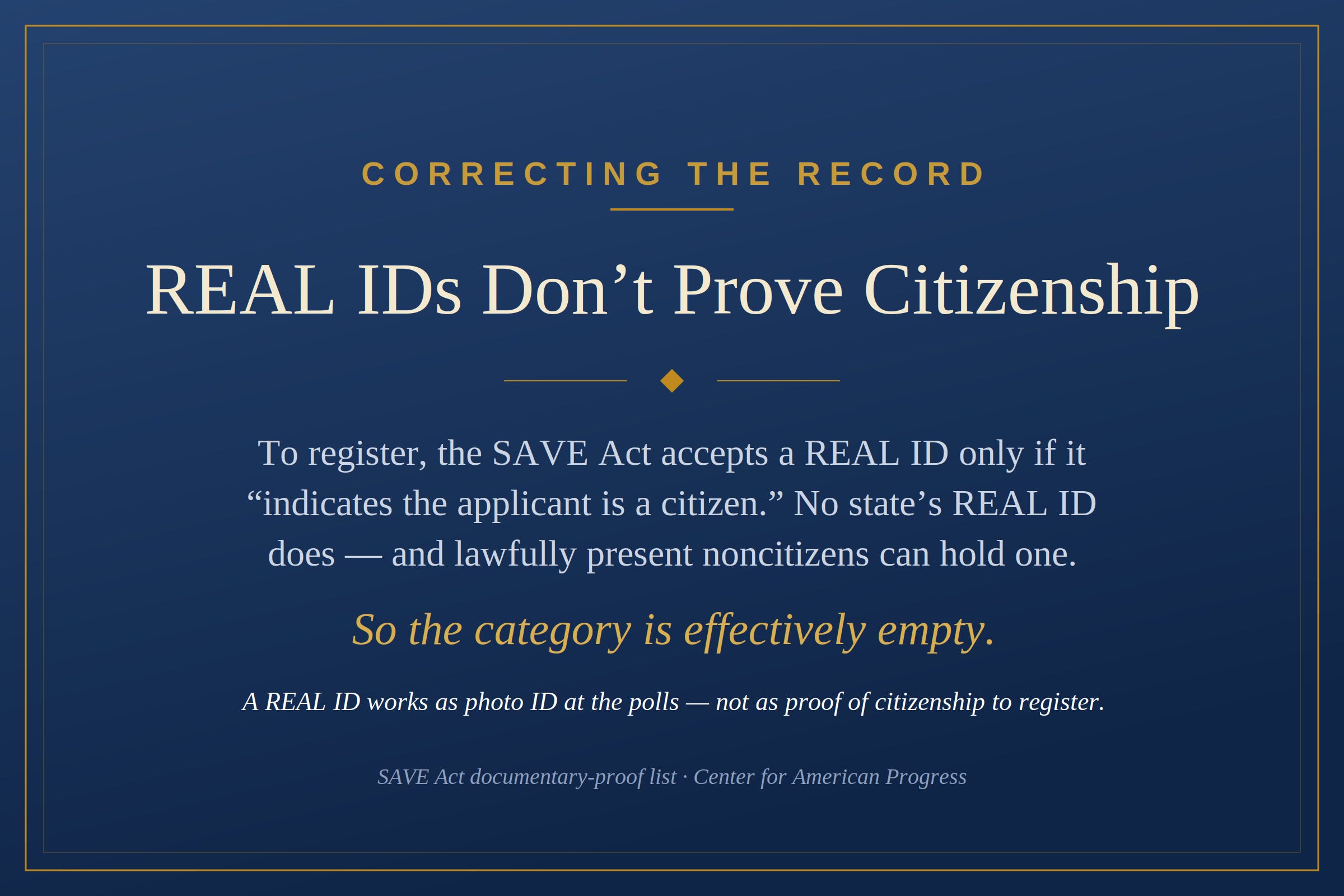
For most citizens, compliance means a passport or a certified birth certificate. Government-issued driver’s licenses — including REAL IDs — and military or tribal IDs do not satisfy the requirement on their own. (CAP)
REAL IDs do not work. The bill accepts a REAL ID “that indicates the applicant is a citizen” — but no state’s REAL ID indicates citizenship, and lawfully residing noncitizens can obtain one. (CAP)
Naturalized citizens must produce a naturalization certificate. (H.R. 22 text)
Who does not have the documents.
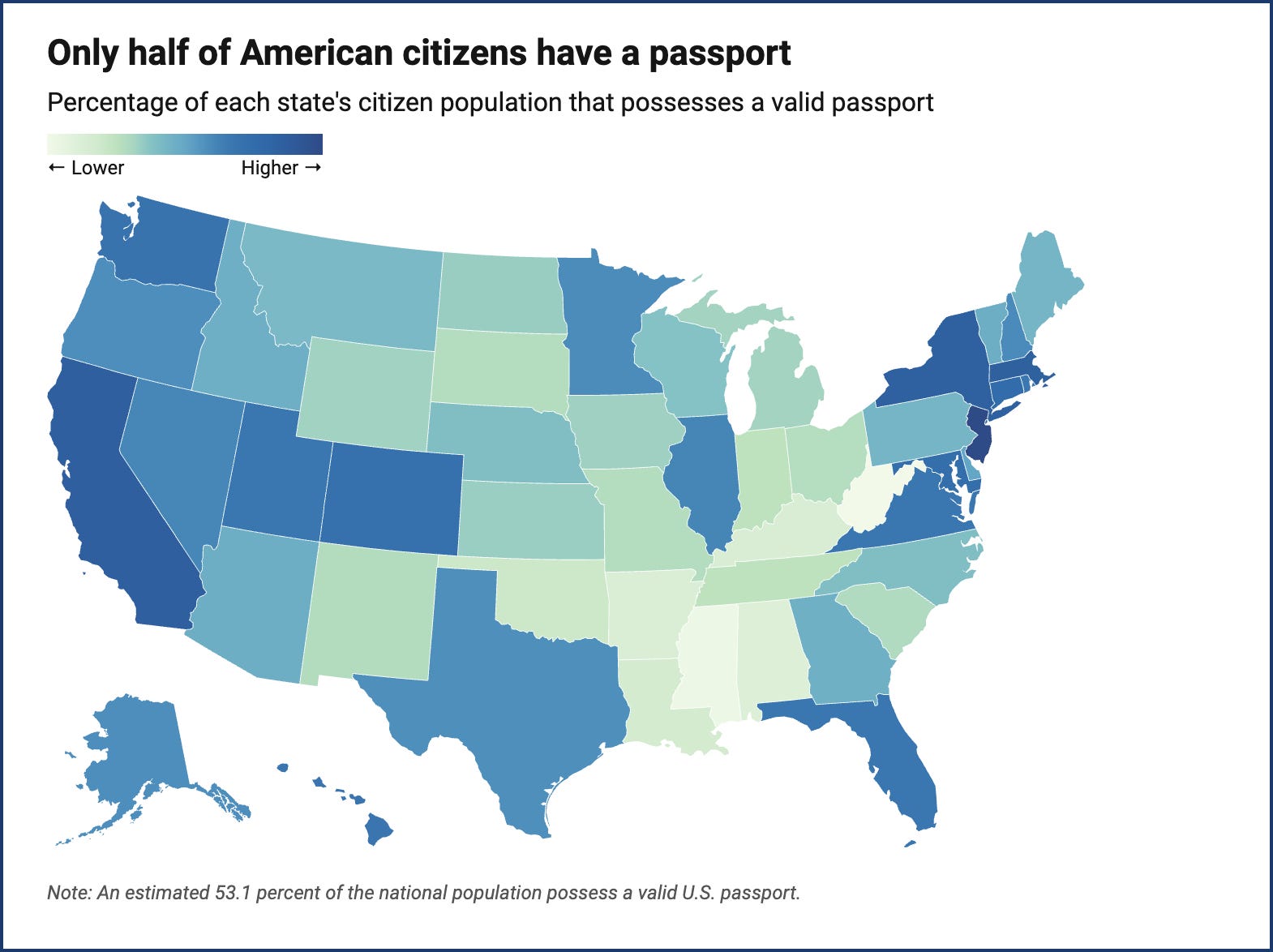
About 146 million American citizens do not hold a valid passport (for scale, 153 million voted in 2024). Low passport rates concentrate in red states; in seven — West Virginia, Mississippi, Alabama, Arkansas, Kentucky, Louisiana, Oklahoma — fewer than one-third of citizens hold one. (CAP)
Only 1 in 4 Americans with a high-school education or less, and only 1 in 5 earning under $50,000, hold a valid passport. (CAP)
As many as 69 million American women lack a birth certificate matching their current legal name, because roughly 84% of married women change their surname. The bill does not provide for a marriage certificate to bridge the gap. (CAP, citing Pew)
The problem it targets is near-nonexistent, & checks already exist.
Noncitizen voting is already a federal crime (since 1996) and is rare by every measure. Utah reviewed 2M+ registered voters → 1 noncitizen registration, 0 noncitizen votes; Louisiana reached the same result. USCIS data flags about 0.04% of verification cases, and many had already proven citizenship at registration. (Vote.org)
Officials already verify eligibility against DHS citizenship data, Social Security data, death records, and postal change-of-address data, and every registrant already provides a driver’s-license number or the last four digits of a Social Security number. (CAP)
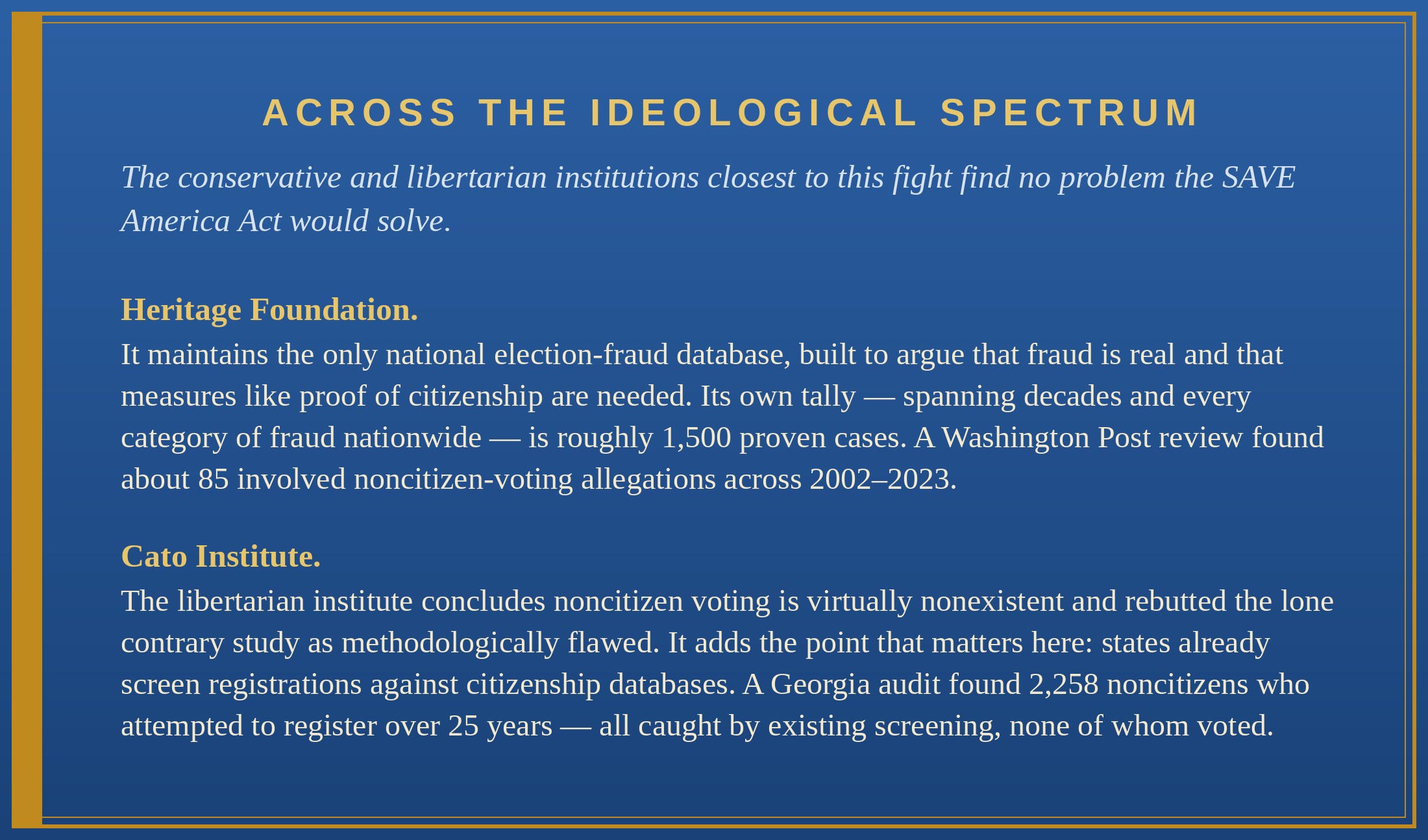
Sources: Heritage Foundation Election Fraud Database; Washington Post review, via CBS News; Cato Institute, The Right’s Bogus Claims about Noncitizen Voting Fraud.
Outcome data, not projection.
Kansas: noncitizen registration ran near 0.002%. After a documentary-proof requirement → ~31,000 eligible citizens blocked, ~12% of applicants. Arizona: comparable result. Federal courts struck both down.
The enforcement tell.
The administration controls the Justice Department. If the fraud the speech alleges were real and provable, prosecutions at that scale would have followed. None have.
Liability shifts to officials; the votes are not there.
Election officials face criminal exposure for registering a voter later found to lack documents, including good-faith error; the Bipartisan Policy Center — which supports citizen-only voting — notes most offices are not equipped to verify document authenticity. (BPC)
Passage requires 60 Senate votes; Republicans hold 53; the necessary Democratic votes have not materialized; Republicans including the co-sponsor say it will not pass. (The SAVE Act Ultimatum Is a Tell)
5. Can the President impose these measures without Congress?
Section 2 answers it: no constitutional authority over election rules. The emergency-powers framework confirms it.
No general grant of emergency power in the Constitution.
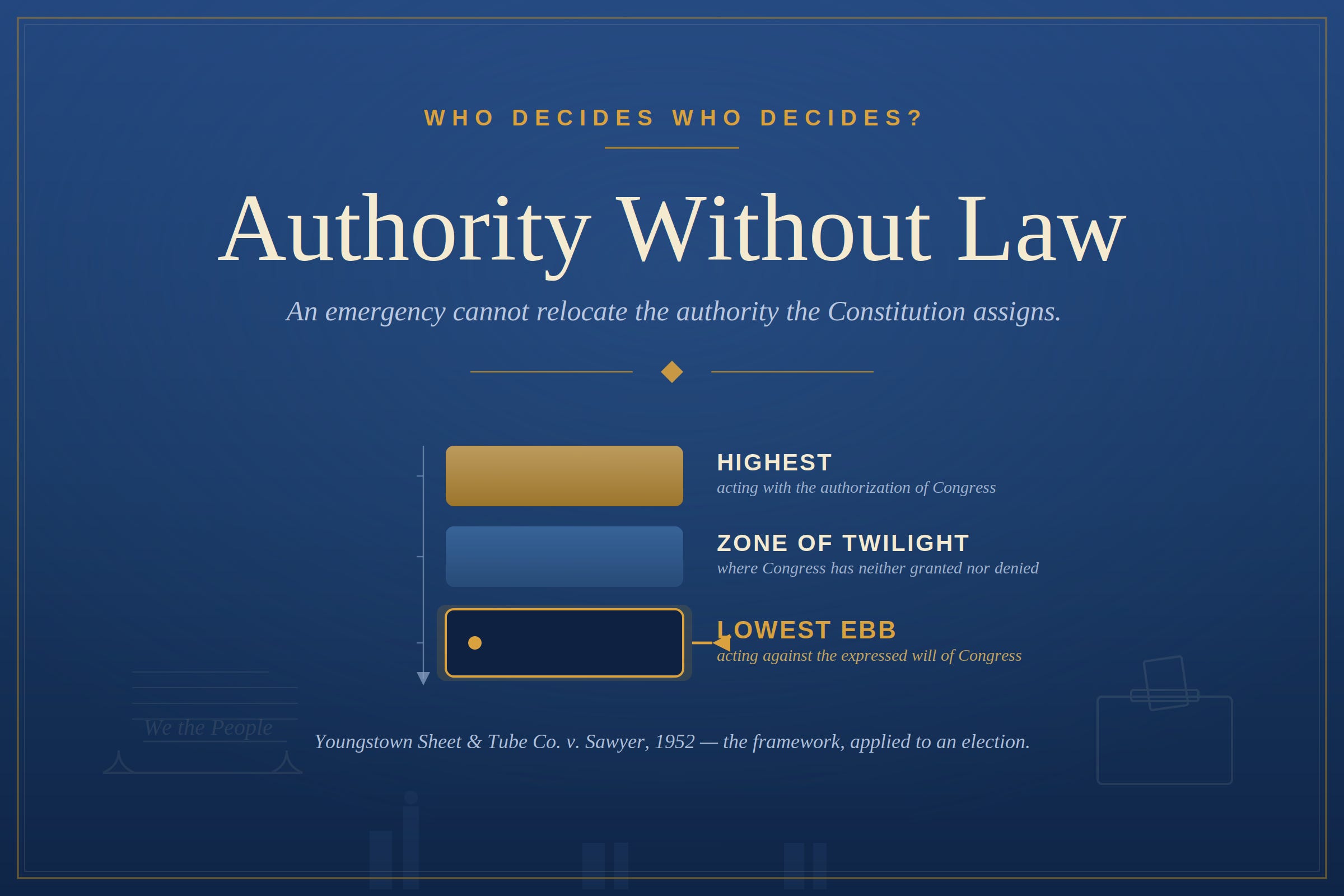
Youngstown (1952), Jackson concurrence — presidential power sorted by relationship to Congress: strongest with authorization; uncertain when Congress is silent; “at its lowest ebb” against the expressed will of Congress.
National Emergencies Act supplies no authority. It is a procedural gate requiring the President to name a specific statute that does. The statutes ordinarily cited do not reach elections.
Learning Resources v. Trump (Feb. 2026): the Court declined to read IEEPA to authorize tariffs; reaffirmed no inherent peacetime authority over powers assigned to Congress.
Applied here.
Congress has repeatedly declined to pass the SAVE America Act.
Imposing its terms by decree = acting against Congress’s expressed will = Jackson’s third category, the weakest — the posture of the invalidated steel seizure.
Binding framework: Dames & Moore v. Regan (1981) adopted it for the Court. (Truman on Trump’s (lack of) Emergency Election Powers)
6. Could he order the National Guard to seize voting machines?
Elections are state-administered. No federal title to the equipment. Posse Comitatus Act restricts military use for domestic law enforcement. Narrow exceptions (incl. the Insurrection Act) address rebellion and enforcement of federal law — not seizure of state election equipment. In a January interview, the President said he regretted not ordering the Guard to seize machines in states he lost in 2020.
7. The NVRA quiet period — what changes on August 5.
National Voter Registration Act: a systematic program to remove ineligible voters must finish at least 90 days before a federal election.
The window opens August 5, 2026 — 90 days before the November 3 general election — and applies to the 44 NVRA states plus D.C.
8. Influence vs. interference — the dispositive distinction.
Influence: shaping voter perceptions, mainly via social media. Documented in 2020.
Interference: technical compromise of voting systems or manipulation of votes. Not found.
2021 National Intelligence Council assessment: no indication any foreign actor tried to alter any technical element of the 2020 process — registration, tabulation, or reporting.
Ratcliffe (DNI, Jan. 2021) argued the assessment understated China’s influence. He did not assert changed vote totals or access to infrastructure.
→ Documented influence is not evidence of interference. The speech’s factual claims depend on merging the two.
9. The speech’s specific claims vs. the released documents.
Claimed, citing newly released “raw” intelligence.
China carried out “the largest compromise of election data in history” in 2020 — 220 million U.S. voter files, creating “ballots for Biden.”
Elections “left vulnerable to being rigged and stolen.”
Venezuela could tamper with voting machines.
The “Deep State” withheld documents on China from him in his first term.
Against the record.
The 220 million “voter files” are public records. Voter rolls with names and addresses are readily available in nearly every state; some are posted online for transparency. Obtaining them is not a hack, and possessing them does not produce a ballot.
“Ballots for Biden” has no support in the released material, which addresses influence, not vote creation or tabulation.
Venezuela was already reviewed and rejected. The 2021 National Intelligence Council review deemed the theory “not credible.”
“They withheld it from me” indicts his own appointee. The 2020 intelligence community was led by John Ratcliffe — then DNI, now his CIA director — and reporting indicates Trump was briefed on the “it failed” conclusion by Ratcliffe himself. Either the threat was catchable and his own DNI missed it, or it was not the historic compromise he now describes.
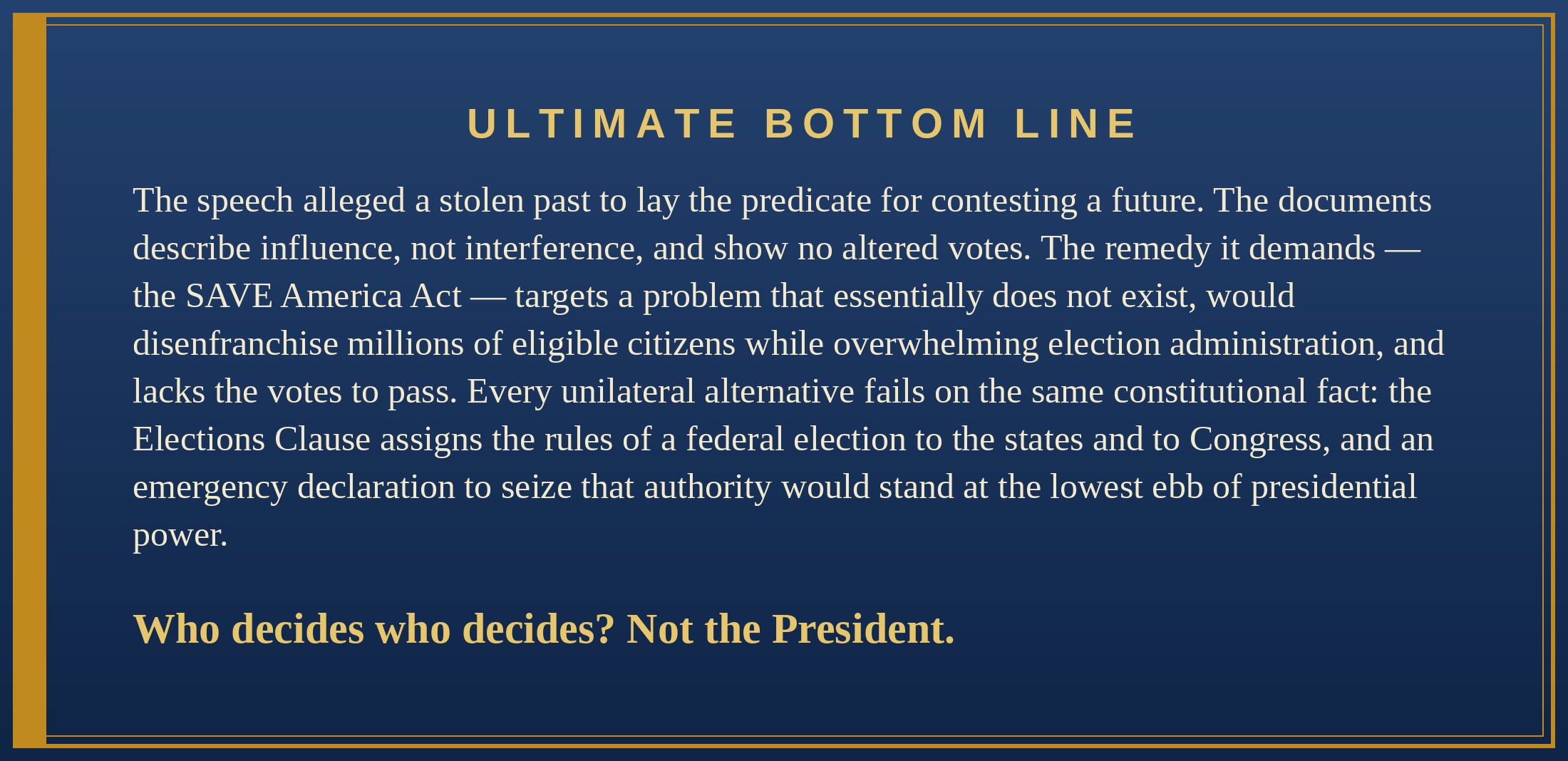
→ The President provided no specific evidence that any votes or the outcome were altered in 2020, despite the “stolen”/“rigged” framing. The evidence released to support the claims undercuts them.
I’m glad you’re here. I’m grateful you’re engaged. Here and everywhere. — James
Thank you so much for the clarity and seriousness here. I deeply appreciate the ability you have to cut through the framing to get at the law and the consequences of it. We are facing dangerous times and must find the fortitude to navigate them with an eye on truth and virtue. I wish I had more optimism about our ability to do so.